

Nearly every compostable trash bag sold in the US carries a certification logo. Those logos do not all mean the same thing, and the difference decides whether the bag is useful to you. A bag certified only for industrial composting needs a commercial facility that accepts compostable liners. A bag certified for home composting can go in a backyard pile.
That split is what this comparison is built around. We looked at twelve brands sold in the US and pulled every spec from the brand's own product listing. Where a brand does not publish a number, the table says so instead of guessing.
Who wrote this. Plastno makes compostable trash bags, so we have a stake in this category. Brands are listed alphabetically rather than ranked, every spec is sourced from the brand's own listing, and we have named the spec where our own bags come last.
What the certification marks actually mean
Three marks show up on compostable bag packaging in the US, and they answer different questions. Each one links to the certifying body so you can check it yourself.
- BPI certifies to ASTM D6400, the US standard for commercial composting facilities. A BPI mark on its own does not tell you a bag will compost in a backyard pile.
- TUV OK Compost HOME certifies performance at the lower temperatures of a backyard pile. This is the mark to look for if you compost at home.
- CMA is a field test run inside operating facilities rather than in a lab.
None of these marks describe what happens in a landfill. Composting depends on oxygen and microbial activity that a landfill does not supply, so a certification only pays off if the bag actually reaches compost. If you have no curbside compost pickup and no backyard pile, a certified bag will not do the thing you bought it for. That is worth settling before you compare anything else.
Compostable trash bags compared
All figures below are for each brand's 13 gallon tall kitchen bag, taken from the brand's own listing.
| Brand | Certifications stated | Thickness | Bags per pack |
|---|---|---|---|
| AYOTEE | Not stated in listing | 1.18 mil | 60 |
| BioBag | BPI, ASTM D6400 | Not published | 48 |
| Compostic | Home compostable, standard not stated | Not published | 100 |
| HoldOn | BPI, industrial only | Not published | 40 |
| Matter | BPI industrial, TUV industrial, TUV home | Not published | 40 or 60 |
| OrangeBio | BPI, ASTM D6400, OK Compost Home | 0.9 mil | 50 |
| Plastno | BPI industrial, TUV OK Compost HOME | 1 mil | 30 |
| Repurpose | BPI, certified home compostable | Not published | 75 |
| Simply Bio | BPI, ASTM D6400, OK Compost Home | 1 mil | 30 |
| SUPERBIO | BPI, OK compost HOME | Not published | 30 |
| TERRACOR | ASTM D6400 | 1 mil | 35 |
| UNNI | BPI, CMA, TUV OK Compost HOME | 0.9 mil | 50 or 100 |
Two things stand out. Half of these brands do not publish a thickness at all, so strength claims on those bags cannot be checked against a number. And among the six that do, 1 mil is not the top of the range. AYOTEE publishes 1.18 mil, and Simply Bio and TERRACOR match Plastno at 1 mil. Thickness is no longer what separates these bags. Pack count is, and it runs from 30 to 100.
Closer looks at five of these brands follow.
HoldOn

HoldOn sells a 13 gallon tall kitchen bag in boxes of 40, built triple ply to resist leaks. Their listing describes the bag as BPI certified industrially compostable, and adds its own caution that composting facilities may not exist in your area. HoldOn also sells a 4 gallon size in boxes of 50.
The industrial-only certification is the thing to weigh. If your city runs a compost program that accepts certified liners, that is a match. If you compost in the backyard, HoldOn is the one brand here that does not carry a home certification.
Matter

Matter carries the broadest set of marks in this group. Its listing and its Target listing both show BPI industrial, TUV industrial, and TUV home certification, which covers a backyard pile and a commercial facility. The 13 gallon bag measures 24 by 29 inches, comes with a drawstring, and is sold in 40 and 60 count packs.
Matter is also the easiest of these to buy in a physical store rather than online, which matters more than spec sheets do if you would rather not wait on shipping.
Plastno

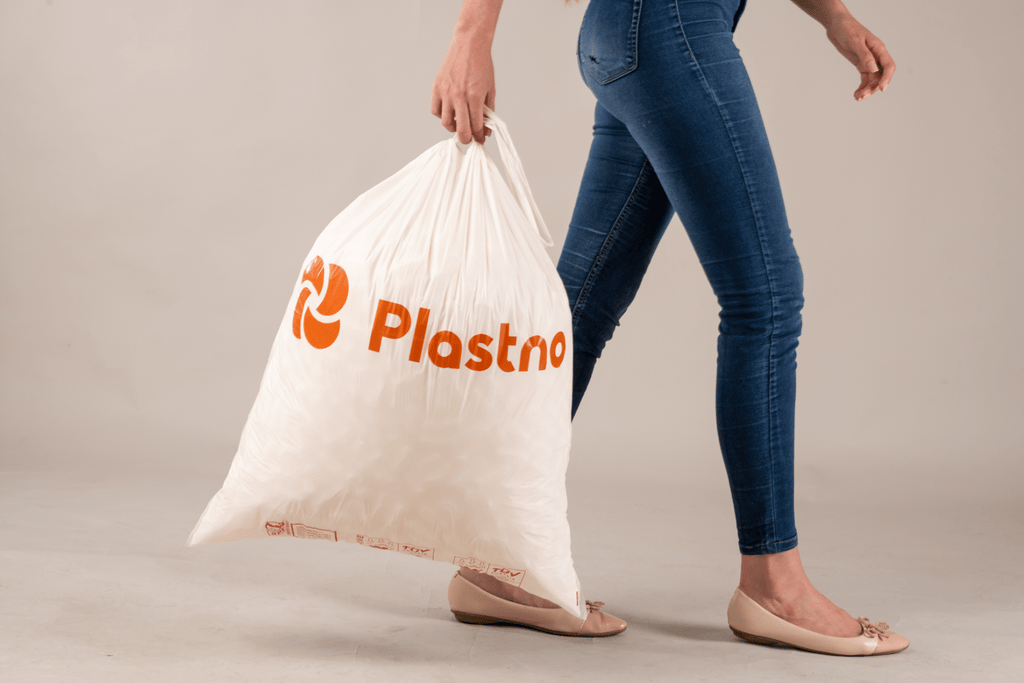
Our 13 gallon compostable trash bags are made from a cornstarch, PLA, and PBAT blend, measure 24 by 28 inches at 1 mil, and come 30 to a roll. They are BPI certified for commercial composting and TUV OK Compost HOME certified for backyard composting. The bottom is flat-sealed and the top has a drawstring. The wrapper is kraft plastic-free paper and the outer is kraft cardboard.
In independent testing by a professional cleaner, one bag held 24 lb for 20 minutes without failing. None of the other brands in this comparison publishes a tested load figure, so that is one number you cannot compare across the table above.
The honest tradeoffs: 30 bags per roll ties for the smallest pack in this comparison, and the plant-derived material has a shelf life of about 12 months, so buying a year's supply at once works against you. Three to four months at a time is the right order size. Draining wet waste before tying off also does more for bag strength than any thickness number will.
Repurpose

Repurpose sells its 13 gallon tall kitchen bag in packs of 75, one of the highest counts in this comparison. The listing describes the bags as BPI certified and certified home compostable, and notes they are approved for use with Lomi countertop composters. Repurpose does not publish a thickness or bag dimensions.
If you go through bags quickly and want the fewest reorders, this is the pack size to beat.
UNNI

UNNI publishes a 0.9 mil thickness on its 13 gallon bag and sells it in 50 and 100 count packs. It is the most heavily certified bag here, carrying BPI to ASTM D6400, CMA field testing in operating facilities, and TUV OK Compost HOME. UNNI also sells 2.6 gallon and 3 gallon sizes for countertop food scrap bins.
The CMA mark is the one worth noting. It comes from testing inside real facilities rather than a lab, which is a different kind of evidence than the other certifications provide.
What is the difference between compostable and biodegradable trash bags?
Compostable is a defined, testable claim. Biodegradable is not. A compostable bag has been certified against a standard such as ASTM D6400 or OK Compost HOME, which specifies the conditions, the timeframe, and what has to be left behind. Biodegradable has no equivalent standard behind it in the US, so the word can appear on a bag that behaves nothing like a certified one.
In practice this means a certification logo tells you far more than the word on the front of the box. If you are trying to tell whether a bag is genuinely compostable, the mark and the standard number are what to read.
Are compostable garbage bags worth it?
It depends entirely on where the bag ends up. Sent to a composting facility or a backyard pile, a certified bag composts and the conventional liner it replaced would not have. Sent to a landfill, it does not get the oxygen composting requires, and the environmental case for it largely disappears.
So the question to answer first is not which brand is strongest. It is whether you have somewhere for the bag to go. Households with curbside compost pickup or a backyard pile get the full benefit. Households without either are paying for a certification they cannot use.
Do compostable bags still have microplastics?
The certifications test for it. ASTM D6400 and OK Compost HOME both require the material to disintegrate and to leave no harmful residue in the environment the bag is certified for. Fragment limits are part of the standard, which is the main practical difference between a certified bag and one that only says biodegradable on the box.
The honest part: most bags in this category, ours included, blend plant starch with PBAT, and PBAT is petroleum-derived. It is engineered to break down under composting conditions rather than to persist. Send it to a landfill instead and it does not get those conditions, so it is not doing the thing it was certified to do.
What are the disadvantages of using compostable trash bags?
There are four, and they apply to our bags as much as anyone's.
They cost more per bag than conventional liners. They have a shelf life, usually around 12 months, so buying a year's supply at once works against you. They are less forgiving of wet waste left sitting, which is why draining before you tie off matters more here than with a plastic liner. And the whole case for them collapses if the bag has nowhere to go, because a compost certification is worth nothing in a landfill.
Ours add a fifth. At 30 to a roll we tie for the smallest pack in this comparison, so you reorder more often than with a big-box count of 100.
What is the most environmentally friendly trash bag?
Often it is no bag at all. If your city collects loose food scraps or you keep a backyard pile, an unlined bin or a plain paper bag beats every liner in this comparison, plant-based ones included. NYT Wirecutter has made that argument and it is a fair one. We sell these bags and we would still rather you knew it.
Where a liner is genuinely required, the most environmentally friendly one is whichever is certified for the system you actually have. A home certification such as TUV OK Compost HOME if you compost in the backyard, BPI if your curbside program asks for it. Matching the certification to the destination does more than any material claim on the front of the box.
How to pick one
Work through it in this order.
- Confirm where the bag will go. Backyard pile, curbside compost program, or neither. This rules more options in and out than any other factor.
- Match the certification to that answer. Backyard composting needs a home certification such as TUV OK Compost HOME. A curbside program needs whatever that program specifies, which is usually BPI.
- Check whether the brand publishes any strength evidence. Six of these twelve publish a thickness, and only one publishes a tested load. For the rest you are relying on adjectives rather than a number.
- Then compare pack size. Counts range from 30 to 100 per pack across these twelve, which is the widest spread of any spec here.
Certification first, specs second. A stronger bag with the wrong certification still ends up in the wrong place, and that is the part that decides whether any of this was worth doing.
Certification standards referenced above are linked to the certifying bodies: BPI, ASTM D6400, TUV OK Compost HOME, and CMA.
Specs verified August 2026 and sourced from each brand's own product listing. Brands change formulations and pack sizes, so check the current packaging before you buy.



Share:
Surprising Truth: Paper & Bamboo Straws with PFAS vs. Plastic Straws | Eco-friendly Alternatives
Cleaning with Vinegar, the Dos and Don'ts