

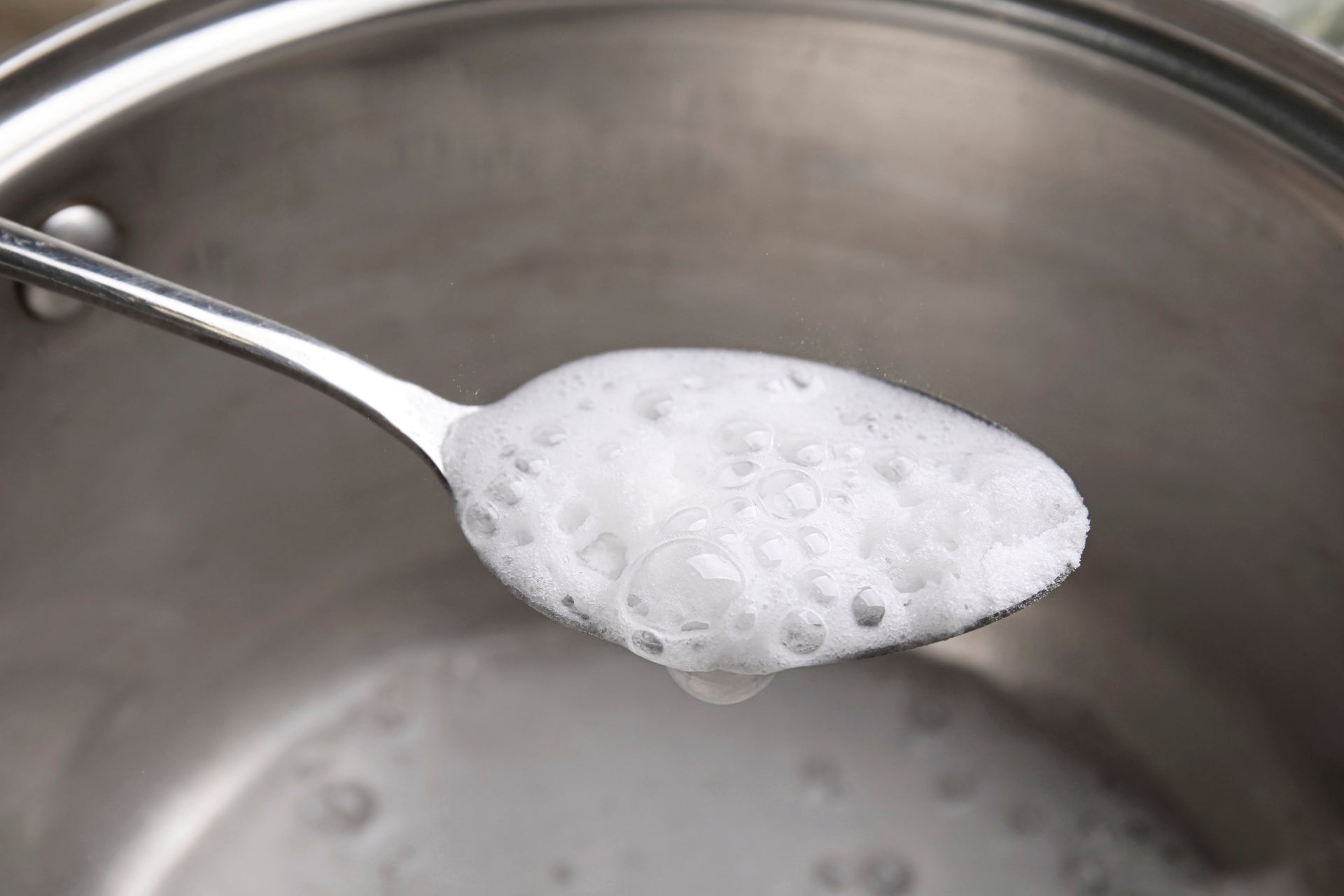
Three white powders sit in most cleaning cupboards, and almost nobody is confident about which is which. Baking soda, washing soda, and borax look nearly identical, get recommended interchangeably in the same DIY articles, and behave very differently once they hit water.
They are not substitutes. One is mild enough to brush your teeth with, one is caustic enough to need gloves, and one is a genuinely contested ingredient. Mixing them up either wastes your time or damages a surface.
Here is what each one actually is, what it cleans, and where it does not belong.
The short version
Baking soda is sodium bicarbonate. Mild, safe to eat, pH around 8.3. A gentle abrasive and a deodorizer.
Washing soda is sodium carbonate, also sold as soda ash or soda crystals. Strongly alkaline, pH around 11, not edible, and an irritant to skin and eyes. A grease cutter and water softener.
Borax is sodium tetraborate. Alkaline, pH around 9.2, a laundry booster and stain helper, and the one with an active safety debate around it.
The critical distinction is that jump from pH 8.3 to pH 11. It sounds small. Because pH is logarithmic, washing soda is roughly a few hundred times more alkaline than baking soda, which is why it cuts grease that baking soda only smears around.
Is washing soda just baking soda?
No, and this is the most common mix-up of the three. They are chemically related, and you can convert one into the other, which is where the confusion comes from.
Sodium bicarbonate is NaHCO3. Sodium carbonate is Na2CO3. Heat baking soda in a dry oven and it releases water and carbon dioxide and becomes washing soda. That is a real and repeatable reaction, and it is why some DIY guides tell you to bake baking soda.
The practical consequence is that they are not interchangeable in a recipe. Substituting washing soda where a recipe expects baking soda gives you something far more caustic than intended, which is a problem on aluminum, on unsealed stone, on waxed wood, and on your hands.
Is washing soda the same as borax?
No. Different compounds entirely, and this one matters because they are used for overlapping jobs so people assume they are equivalent.
Washing soda is a carbonate. Borax is a borate, a boron mineral compound. Both boost laundry detergent and both soften water, but the mechanisms differ and so does the safety profile. Washing soda is more aggressive on grease; borax is better on certain protein and organic stains.
What each one is actually good at
Baking soda
Its real strengths are mildness and mechanical action. As a paste it is a fine abrasive that will not scratch most surfaces, which makes it genuinely good for burnt-on residue in pans, tea stains in mugs, and scrubbing a sink without scoring it. It absorbs odors in a fridge or a bin. It is safe around food surfaces and safe on skin.
What it is not is a degreaser. Baking soda on a greasy stovetop mostly moves the grease around. That job belongs to an alkaline cleaner or a surfactant.
Washing soda
This is the heavy lifter. High alkalinity saponifies fats, meaning it converts grease into something water can carry away, so it earns its place on greasy range hoods, oven interiors, and heavily soiled laundry. It also binds calcium and magnesium in hard water, which is why it makes detergent work better in hard-water areas.
Handle it with gloves. At pH 11 it is an irritant, and prolonged skin contact is genuinely unpleasant. Keep it off aluminum, which it will dull and corrode, off unsealed or waxed wood, and off unsealed natural stone.
Borax
Useful as a laundry booster, on some organic stains, and as a mild water softener. Also widely used in slime recipes, which is how most of the safety conversation started.
The honest position on borax safety: it is more contested than the other two. It is restricted in some consumer applications in the European Union, and there is reproductive-toxicity concern at high exposures. Plenty of toxicologists consider ordinary household use with gloves and no ingestion to be low risk. It is not the emergency some corners of the internet suggest, and it is not the nothingburger that DIY blogs imply. If you have young children who might handle it, or you are pregnant, it is a reasonable one to skip, and the other two will cover almost everything you needed it for.
Is sodium carbonate good or bad for you?
Neither, in the way the question implies. It depends entirely on exposure.
Washing soda in a bucket of cleaning water is a normal household chemical with a long safety record. Washing soda powder on bare skin for an extended period is an irritant. Swallowed, it is genuinely harmful and needs medical attention. None of that makes it a dangerous thing to own, it makes it a thing that wants gloves and a shelf children cannot reach.
It is also worth saying that sodium carbonate is not a synthetic novelty. It occurs naturally in mineral deposits called trona, and it has been used for cleaning and glassmaking for centuries. Most of it is either mined or produced from salt and limestone.
Two combinations to skip
Since these powders show up in DIY recipes constantly, two warnings are worth more than another tip.
Do not mix any of them with bleach. Bleach reacts badly with a number of household chemicals, and the safe rule is to use bleach alone and never as an ingredient in a homemade blend.
Do not bother mixing them with vinegar. It fizzes impressively, which is why the internet loves it, but an acid and an alkali cancel each other out. What you are left with after the foam settles is mostly salty water with a fraction of the cleaning power either ingredient had on its own.
Which to reach for
A rough guide by job. Greasy stovetop or oven: washing soda. Scrubbing a sink or a scorched pan: baking soda paste. Smell in the fridge or bin: baking soda. Hard water making laundry dingy: washing soda. Protein stains on fabric: borax, if you keep it. Daily wipe-down of a sealed counter: none of them on their own, because a bare alkali is not a formulated cleaner and will streak.
Why sodium carbonate is the first ingredient in our tablets
That last line is the reason it matters to us. Alkalinity alone cuts grease but leaves residue and does nothing to help water spread across a surface. Formulation is what turns an alkali into something you can spray on a counter and wipe once.
Sodium carbonate is the first ingredient in our non-toxic cleaning tablets for exactly the reason described above: it does the grease-cutting work. Around it sit tartaric acid to moderate the pH into a range that is safe on sealed stone, two gentle plant-derived surfactants so the cleaner sheets across a surface instead of beading, and sodium phytate to bind hard-water minerals so you do not get spotting. Eight ingredients total, published in full on our ingredients page.
The result is a spray that is safe on sealed countertops, stovetops, sealed wood, and sealed stone including marble, granite, quartz, travertine and terrazzo. It is not formulated for floors, glass or mirrors. It is not EPA registered, so it cleans and we make no disinfecting or sanitizing claim. No fragrance, no dye, and no PVA film.
If you want to keep using raw washing soda for the heavy jobs, that is a perfectly good choice and it will outperform any all-purpose spray on a greasy oven. The two are not really competing. One is a bulk alkali for hard jobs, the other is a balanced formula for the surfaces you wipe every day.
If you would rather work out for yourself which cleaning claims hold up, we wrote a guide to verifying non-toxic cleaning products that covers how to read an ingredient list.
Share:
Non-Toxic Cleaning Products: How to Tell Which Claims Are Real
How to Clean Granite and Marble Countertops (Skip the Vinegar)