

Polyvinyl alcohol, usually shortened to PVA or PVOH, is the clear film that wraps a laundry pod and the binder that holds many cleaning tablets together. It dissolves in water and vanishes from sight, which is exactly why it appears in so many products that market themselves as low-waste.
The questions people actually ask about it are simpler than the chemistry: is it a plastic, and is it safe? Both have real answers, and one of them is genuinely unresolved. Here is what is established, what is contested, and why we formulate without it.
Is polyvinyl alcohol a plastic?
Yes. Polyvinyl alcohol is a synthetic polymer, which puts it in the same broad family as the plastics you can hold. What makes it unusual is that it is engineered to be water-soluble, so instead of staying solid it disperses into the water around it.
This is where most of the confusion starts. Dissolving looks like disappearing, but the two are not the same thing. When sugar dissolves in tea the sugar is still there. When PVA film dissolves in your washing machine, the polymer is still there too, now dispersed in the water heading down your drain.
So a product wrapped in PVA film is not plastic-free in the sense most shoppers mean. It is plastic that you cannot see anymore.
Is polyvinyl alcohol toxic to humans?
On the evidence available, PVA has low acute toxicity for people. It is poorly absorbed through the gut, it is used in some eye drops and in pharmaceutical coatings, and it is not classified as a carcinogen. If you are worried about handling a laundry pod, that is not the concern worth your attention.
Two caveats matter. First, low toxicity to an adult is not the same as harmless in every scenario, and undissolved pods have been a genuine child-safety issue, which is about the concentrated detergent inside as much as the film. Second, and more importantly, human toxicity is not the question that PVA actually raises. The open question is environmental.
The part that is genuinely contested
Here is the honest state of things, including the parts that do not favor our position.
PVA is biodegradable under the right conditions. That phrase is doing a lot of work. Specific microorganisms can break it down, and in laboratory conditions and in treatment plants that host the right bacterial cultures with enough contact time, it degrades substantially.
The dispute is about what happens in the real world. Wastewater treatment plants vary enormously in design, retention time, and microbial population. Research has raised the concern that a meaningful fraction of household PVA passes through standard municipal treatment without fully degrading, ending up in waterways and in sludge that is often spread on farmland. Industry-funded assessments generally conclude that degradation is high and the concern is overstated. Independent researchers have published estimates that are considerably less reassuring.
We are not going to pretend this is settled, because it is not. Anyone who tells you PVA is definitively harmless is overreaching, and so is anyone who tells you it is definitively a pollution crisis. What is fair to say is that the degradation depends on infrastructure you do not control and cannot check.
Is PVA a microplastic?
This is where the argument gets semantic, and the semantics matter.
Microplastics are usually defined as solid plastic particles under five millimeters. PVA that has dissolved is not a solid particle, so by the strict definition it does not qualify while it stays dissolved. Trade bodies lean on this distinction, and technically they have a point.
The counterargument is that the definition was written around particles that were visible and countable, not around a polymer designed to disperse. A dissolved synthetic polymer entering a waterway is not obviously better than a solid one just because it is harder to measure. Some researchers argue dissolved polymers should be tracked in the same conversation.
Our read: arguing about whether it meets a particular definition is less useful than asking whether you want a synthetic polymer in the water at all when the product works fine without one.
Where you will find PVA
Worth knowing, because it is more places than people expect.
- Laundry pods and detergent sheets: the dissolving pouch is almost always PVA. Some sheets are essentially PVA film with detergent in it.
- Dishwasher pods: same film.
- Cleaning tablets: either an outer film or an internal binder holding the tablet together.
- Toilet and drain products: dissolving sachets.
- School glue: the answer to a question Google asks a lot. White school glue is typically polyvinyl acetate, a related but different compound. Similar family, different material.
Reading the label is harder than it should be. PVA in an outer film is frequently not listed as an ingredient at all, because the film is treated as packaging rather than formula. If a label lists nothing but the product still arrives as a neat dissolving pouch, the film is almost certainly there.
How to check a product yourself
Three questions get you most of the way.
Does it come in a pouch that dissolves? Then assume PVA film unless the brand explicitly says otherwise. Does the ingredient list include polyvinyl alcohol, PVOH, or polyvinyl acetate? Then it is in the formula, not just the wrapper. Does the brand claim "plastic-free" while shipping a dissolving pod? Then ask them directly what the film is made of, because those two things are usually in tension.
A brand that formulates without it will generally say so plainly, because it is difficult and they want credit for it.
How our tablets work without it
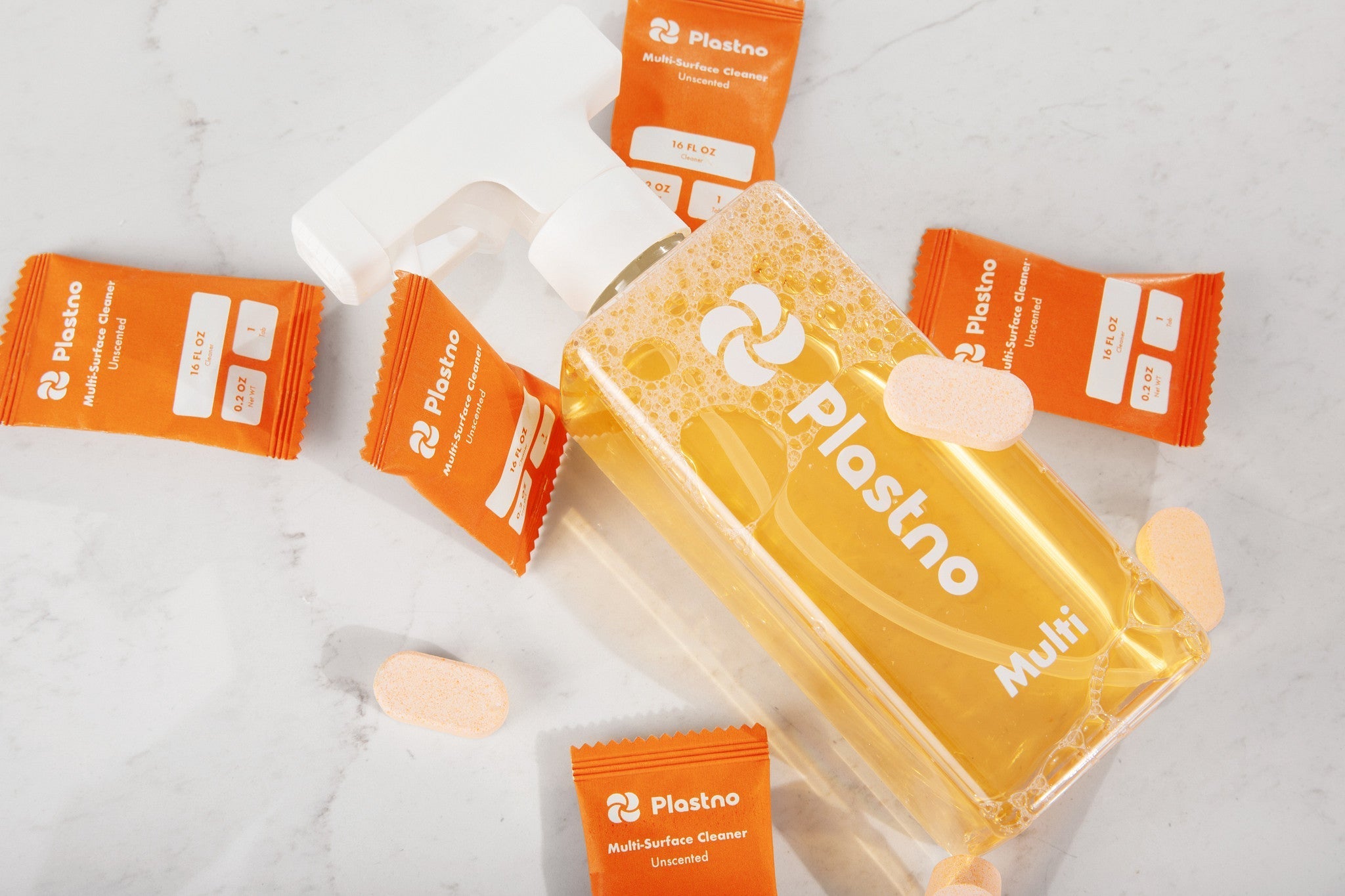
Our non-toxic cleaning tablets, and everything else in our non-toxic cleaners range, contain no PVA. No dissolving film around the tablet, and no polyvinyl alcohol or polyvinyl acetate acting as a binder in the formula.
The tablet holds its shape through compression and the properties of the eight mineral-based ingredients themselves, which are published in full on our ingredients page: sodium carbonate, tartaric acid, sodium N-lauroylsarcosinate, sodium lauroyl glutamate, sodium benzoate, sodium chloride, sodium phytate, and glycerin. Glycerin is the ingredient doing much of the work a synthetic binder would otherwise do.
The practical trade-off, stated plainly: a tablet without film needs a paper wrapper to survive shipping, and it takes 20 to 30 minutes to dissolve rather than seconds. That is a real inconvenience and worth knowing before you buy. PVA is popular because it genuinely solves engineering problems. We accepted a slower dissolve and a wrapper instead.
To use one, fill a refillable spray bottle about ninety percent with warm water, drop in a tablet, and leave it for 20 to 30 minutes until it has dissolved completely before attaching the nozzle. Each tablet makes 16 ounces of cleaner for sealed countertops, stovetops, sealed tile, sealed wood, and sealed stone including marble, granite, quartz, travertine and terrazzo. It is not formulated for floors, glass or mirrors, and it is not EPA registered, so it is a cleaner and we make no claim that it disinfects or sanitizes.
The tablets are Leaping Bunny certified cruelty-free, which covers animal testing and says nothing about ingredient safety or environmental impact. We are not EWG Verified, though the tablet is under EWG assessment as of June 2026, and we will not claim that certification until it is granted.
Whether PVA-free should change what you buy
An honest ranking, since PVA is one factor among several.
If you are choosing between a PVA pod and a rigid plastic jug of the same product, that is a genuinely close call and reasonable people land differently. If you are choosing between a PVA pod and a refill system with no film and no bottle, the film-free option removes a material whose fate you cannot verify. And if a product is wrapped in PVA while being marketed as plastic-free, the more useful signal is not the film itself but the fact that the brand is comfortable with that gap.
That last point is the one we would keep. PVA is a contested material, and how a company talks about a contested material tells you how they will handle the next one. If you want the fuller version of that method, we wrote a guide to checking which cleaning product claims are real, and a companion piece on what sulfates do and why we leave them out.
Share:
What TUV OK Compost HOME Means for Plastno Trash Bags
Mineral-Based Cleaning Sprays for Small Kitchens That Get Messy Quickly