

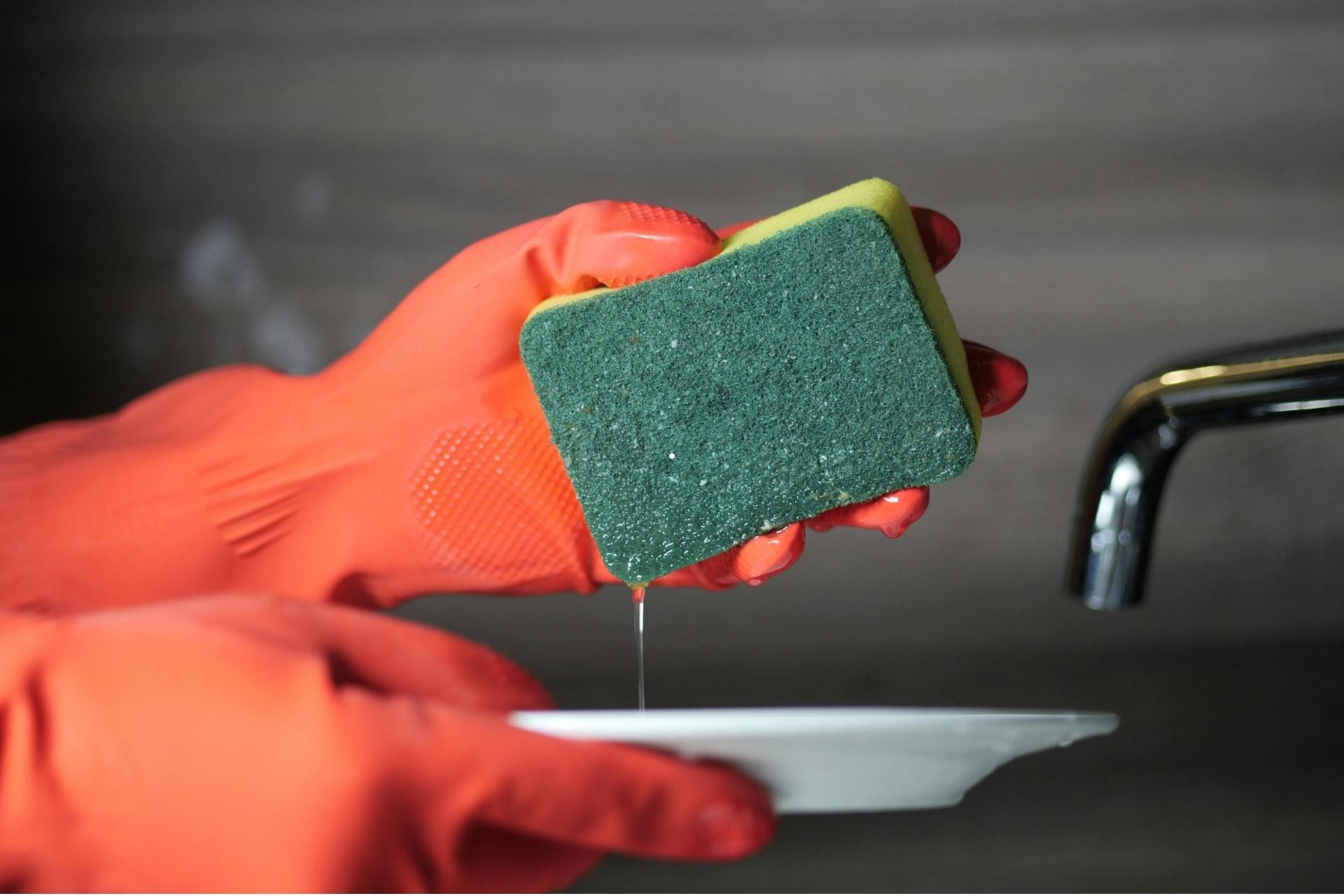
Most kitchen sponges are plastic. The yellow block is polyurethane foam, the green pad bonded to it is polyester or nylon fiber, and both shed particles every time you scrub. That is the part people are trying to get away from when they go looking for a non-toxic sponge.
The catch is that the plant-based aisle is not automatically plastic-free. Plenty of sponges sold as natural have a cellulose body and a synthetic scouring layer bonded to the back, so the swap only covers half the sponge. This comparison is built around that split. We looked at seven sponges from three brands and pulled every spec from the brand's own product listing. Where a brand does not publish a number, the table says so instead of guessing.
Who wrote this. Plastno makes two of the sponges below, so we have a stake in this category. Brands are listed alphabetically rather than ranked, every spec is sourced from the brand's own listing, and we have named the specs where our own sponges come last.
What the scrub layer is actually made of
A dual-sided sponge is two materials, and they are usually sourced separately. The soft side absorbs. The rough side scours. A brand can make the soft side from cellulose, call the sponge plant-based, and still bond a plastic mesh to the back of it.
So the question worth asking about any eco sponge is what the scrub side is made of, not what the sponge is made of. Read the material list for polyester, polyurethane, nylon, polypropylene, PET, or the phrase recycled plastic. Any of those puts plastic in the part of the sponge that gets abraded hardest.
Full Circle is the clearest case, and to their credit they publish it. Their Walnut Shell Scrubber Sponge lists walnut shells, cellulose, and recycled plastic. Their Coconut Husk Scrubber Sponge lists cellulose, certified recycled plastic, and coconut husk. Their Walnut Shell Scour Pad names it more precisely as recycled water bottles, or rPET. Those are plant abrasives held in a plastic web, and recycled plastic sheds the same way new plastic does.
Dish sponges compared
All figures below come from each brand's own product listing.
| Brand and product | Materials | Dimensions | Lifespan | Plastic scouring layer? |
|---|---|---|---|---|
| Blueland Pop-Up Sponge | Plant-based cellulose | Not published | Not published | No scrub side |
| Blueland Scrub Sponge | Loofah and cellulose, hand-sewn with cotton thread | Not published | Not published | None stated. Listed as free of all plastics |
| Full Circle Coconut Husk Scrubber Sponge | Cellulose, certified recycled plastic, coconut husk | 4.75 x 3 x 0.4 in | Not published | Yes. Certified recycled plastic |
| Full Circle Plain Jane | 100% cellulose | 4.25 x 2.75 x 0.4 in | Not published | None. Listed as pure cellulose, no plastic |
| Full Circle Walnut Shell Scrubber Sponge | Walnut shells, cellulose, recycled plastic | 4.43 x 2.75 x 0.75 in | Not published | Yes. Recycled plastic |
| Plastno Scrub Sponge | Loofah scrub side, cellulose wash side, biodegradable | 3.75 x 3.75 x 0.5 in | 2 to 4 months | None. The scrub side is loofah, not nylon or polyester mesh |
| Plastno Soak Sponge | Cellulose, single layer, biodegradable | 3.75 x 3.75 in, 0.20 in flat and 0.5 in expanded | 2 to 4 months | No scrub side |
Two things stand out. Only one of the three brands publishes how long its sponges last, and lifespan is the number that decides what a sponge really costs and how much waste it makes. And two of these seven sponges carry a plastic scouring layer, both of them sold in the plant-based aisle.
Blueland
Blueland sells two sponges. The Scrub Sponge has a loofah scrub side and a cellulose wash side, hand-sewn with cotton thread instead of glue or adhesive. Sewing beats an adhesive bond, and it is the thing Blueland does best here. The Pop-Up Sponge is a single cellulose layer that ships flat and expands in water. Both listings say the sponges are free of all plastics, and Blueland's help center says its sponges are compostable when rinsed and discarded correctly.
What Blueland does not publish is a size or a lifespan. Neither product page lists dimensions, and neither the product pages nor the help center gives a replacement interval. Blueland's own blog recommends throwing out a sponge every week or two, but that advice is about conventional plastic sponges rather than theirs. To find out how big either sponge is or how long it lasts, you have to buy one.
Full Circle
Full Circle has the widest sponge range of the three and publishes dimensions on every one, which no other brand here does across a full line. Plain Jane is the pure cellulose option, 4.25 by 2.75 by 0.4 inches, sold in sets of 3 or 8, and the listing describes both the sponge and its packaging as compostable. Sets of 8 is the largest pack in this comparison.
The scrubbers are a different story. The Walnut Shell Scrubber Sponge is walnut shells, cellulose, and recycled plastic at 4.43 by 2.75 by 0.75 inches. The Coconut Husk Scrubber Sponge is cellulose, certified recycled plastic, and coconut husk at 4.75 by 3 by 0.4 inches. Those are the two a shopper reaches for when plain cellulose will not shift baked-on grease, and both put plastic back into the sponge. Full Circle publishes no lifespan for any of them.
Plastno
Our two sponges are both 3.75 by 3.75 inch squares. The Scrub Sponge is 0.5 inches thick with a loofah scrub side and a cellulose wash side. The Soak Sponge is a single cellulose layer that ships 0.20 inches flat and expands to 0.5 inches in water. Both come 3 to a pack, both go on the top rack of the dishwasher or into boiling water for one to two minutes, and both are rated for 2 to 4 months of daily use. Both are biodegradable, made from loofah and plant-based cellulose, and break down in a home compost pile. Not third-party certified.
The scrub side is loofah. There is no nylon or polyester mesh behind it, which is the check worth running on any sponge sold as plant-based.
The honest tradeoffs. Three per pack ties for the smallest count here, and Full Circle's sets of 8 win on unit count alone. Our sponges hold no compostability certification, while both other brands make a compostable claim on their own listings. And the Soak Sponge has no scrub side at all, so a baked-on pan needs the Scrub Sponge or a brush.
What the mainstream sponge lists recommend
Search for the best dish sponge and page one is Wirecutter, Serious Eats, America's Test Kitchen, Bon Appetit, and a Reddit thread. The picks are consistent across all of them: Scrub Daddy, Skura Style, Scotch-Brite, and O-Cedar's Scrunge. Not one of those lists covers plastic-free sponges as a category.
The picks are plastic, and the brands say so themselves. Scrub Daddy's FAQ describes its FlexTexture material as a highly engineered polymer foam. Skura Style's listing says its sponges are made from a highly absorbent polyurethane foam treated with an antimicrobial agent. Scotch-Brite pairs a cellulose sponge with a nonwoven scouring pad, and 3M describes that pad technology as nylon and polyester fibers bonded with resin and abrasive mineral.
None of that makes them bad at washing dishes. They are on those lists because they clean well, which is what those lists tested. It does mean that if microplastics are the reason you are shopping, the standard recommendation list is not answering the question you asked. A 2026 University of Bonn study in Environmental Advances measured 0.68 to 4.21 grams of microplastics released per person per year depending on the sponge, and found that sponges with less plastic in them shed significantly less.
What is the best sponge for washing dishes?
It depends on what you are washing. A single cellulose layer handles everyday plates and glassware and is gentlest on nonstick. A dual-sided sponge with a loofah or plant-fiber scrub side handles baked-on food. If avoiding plastic is the point, the material to check is the scrub side, not the sponge body.
Do kitchen sponges shed microplastics?
Yes. A 2026 University of Bonn study in Environmental Advances measured 0.68 to 4.21 grams released per person per year depending on the sponge, and found sponges with less plastic in them shed significantly less. A cellulose and loofah sponge has no plastic in it to shed.
What is a good alternative to a kitchen sponge?
Cellulose sponges, loofah, coconut coir, walnut shell pads, and Swedish dishcloths all replace a foam sponge. Cellulose and loofah come closest to a straight swap, since they keep the soft side and scrub side a foam sponge has. Check any of them for a plastic scouring layer before buying.
How long should a dish sponge last?
Most brands publish no number at all. Plastno rates both of its sponges at 2 to 4 months of daily use. Blueland and Full Circle publish no lifespan for any sponge in this comparison, and Blueland's own blog recommends replacing a conventional plastic sponge every one to two weeks.
Can you put a plant-based sponge in the dishwasher?
Yes for cellulose and loofah. Plastno sponges go on the top rack, or into boiling water for one to two minutes. Blueland lists the dishwasher or boiling for its sponges, and Full Circle says Plain Jane can be boiled or microwaved. Check the label first on anything with a synthetic scouring layer.
How to pick one
Work through it in this order.
Read the scrub side first. If the material list names polyester, polyurethane, nylon, polypropylene, PET, or recycled plastic, there is plastic in the part of the sponge that abrades. That one check rules more options in and out than anything else here.
Then look for a published lifespan. One brand of the three publishes one. A sponge that lasts three months and a sponge that lasts three weeks are not the same purchase, even at the same pack count.
Then check the dimensions. Two of these brands publish them and one does not, and a sponge is a thing you hold, so size matters more than it sounds like it should.
Pack count last. Counts here run from 3 to 8. It is the easiest spec to compare and the least useful one on its own.
Scrub layer first, lifespan second. A sponge with a good pack price and a plastic mesh on the back is still putting plastic in your sink, which is the thing you were trying to stop.
Microplastic release figures are from Hamann et al., "From sink to sea: Microplastic release from kitchen sponges and potential environmental effects," Environmental Advances, 2026.
Specs verified August 2026 and sourced from each brand's own product listing. Brands change materials and pack sizes, so check the current packaging before you buy.
Share:
How to Clean a Trash Can Indoors Without a Hose
Best Non-Toxic All-Purpose Cleaners Compared