

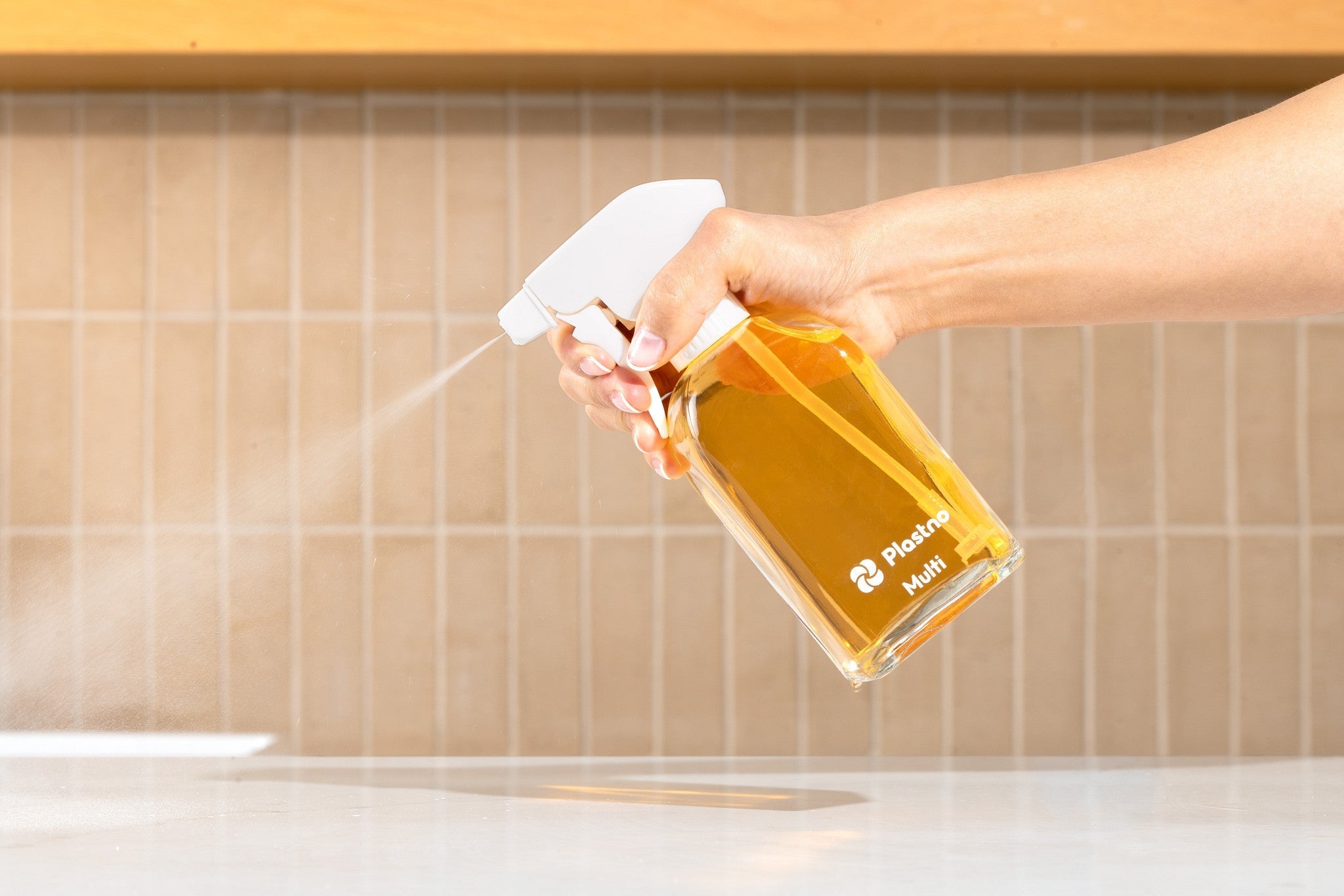
Almost every all-purpose cleaner sold as non-toxic is making one of two trades. Either it is gentle and it struggles on baked grease, or it cuts grease and there is something in the bottle you would rather not spray near food. The marketing on both looks identical from the front of the label.
That split is what this comparison is built around. We looked at seven all-purpose cleaners sold in the US and pulled every ingredient, certification and bottle material from the brand's own listing. Where a brand does not publish something, the table says so instead of guessing.
Who wrote this. Plastno makes one of the cleaners below, so we have a stake in this category. Brands are listed alphabetically rather than ranked, every spec is sourced from the brand's own listing, and we have named the places where our own cleaner comes last.
What safer usually costs you in cleaning power
Cleaning power in this category comes from three things: the surfactant that lifts grease, the alkalinity that breaks it down, and the acid that handles hard-water film. Turn any of them up and you clean better. Turn them up too far and you get ingredients that belong on a warning label.
You can watch the trade happen across these seven. The cleaner with the strongest degreasing chemistry here gets there with sodium hydroxide, which is caustic soda, plus a sulfate surfactant and two isothiazolinone preservatives. The cleaner with the gentlest ingredient list is seven items long with no fragrance at all, and its own brand sells a separate oxygen booster for the jobs it cannot handle. Both are honest products. They are just answering different questions.
The question worth asking of any cleaner marketed as non-toxic is which side of that trade it landed on, and whether the brand tells you.
All-purpose cleaners compared
All specs below were read off each brand's own product page in August 2026. Ingredient lists change, so check the current label before you buy. Ranks are our own assessment of these seven, based on the published ingredient lists and cleaning chemistry in the rows next to them.
| Brand | Format | Ingredients disclosed | Non-toxicity rank | Cleaning power rank | Certifications | Bottle material |
|---|---|---|---|---|---|---|
| Aunt Fannie's | Ready-to-use spray | Yes. Full list per scent | 4 | 6 | Leaping Bunny, EWG A-rated | Not published. PCR plastic where possible |
| Blueland | Tablet, makes 24 oz | Yes. 12 ingredients with CAS numbers | 6 | 3 | EPA Safer Choice, USDA BioPreferred, Leaping Bunny | Tritan plastic |
| Branch Basics | Liquid concentrate | Yes. 7 ingredients, no fragrance line | 1 | 7 | EWG Verified, MADE SAFE | Plastic. Brand states packaging is not biodegradable |
| Cleancult | Ready-to-use liquid | Partial. Fragrance is one line, 4 allergens named | 7 | 1 | None on the product page. Leaping Bunny stated brand-wide | Aluminum |
| Force of Nature | Electrolysis appliance and capsules | Partial. Ingredients named, no list or amounts | 2 | 5 | EPA Safer Choice, Green Seal, Leaping Bunny, National Eczema Association | Glass or plastic, your choice |
| Grove Collaborative | Liquid concentrate vial | Partial. Natural origin fragrance not broken out | 5 | 4 | B Corp, USDA Certified Biobased, Certified Cruelty Free | Glass vial. Spray bottle is plastic |
| Plastno | Tablet, makes 16 oz | Yes. All 8 ingredients | 3 | 2 | Leaping Bunny | Soda-lime glass with a polypropylene trigger |
Two things stand out. Only three of these seven publish a complete ingredient list, and the three that hold back are all holding back the same thing, which is what is inside the word fragrance. And the two ends of the cleaning-power column are held by the two ends of the ingredient column. Cleancult cleans best here and has the ingredient list we would least want to spray near food. Branch Basics has the gentlest formula and the weakest per-application power, which is why its own brand sells a separate booster for hard jobs.
Plastno is the only cleaner in this comparison that sits in the top three of both columns. That is the whole reason we built the product the way we did, and the table above is where you can check it rather than take our word for it.
Aunt Fannie's
The most straightforward formula here. Their All-Purpose Cleaning Spray is distilled white vinegar, one sugar-derived surfactant, triethyl citrate, and essential oils, and they publish the list per scent. They also sell a genuine Fragrance Free version whose entire ingredient list is vinegar and the sugar surfactant. Two items.
What vinegar does well is hard-water film and mineral deposits, because it is acidic. What it does poorly is baked-on grease, because grease needs alkalinity and vinegar has none. A single mild glucoside surfactant does not make up the difference. Their bottle material is not published on the product page; the FAQ says post-consumer recycled plastic is used where possible, with no percentage stated.
Blueland
The best-known tablet brand, and the closest format comparison to ours. One tablet makes 24 ounces against our 16. Their certifications beat ours and it is not close: their Multi-Surface Cleaner is individually listed by EPA Safer Choice and by USDA BioPreferred. We hold Leaping Bunny and nothing else.
Worth being precise about one of their marks. Their page also states Cradle to Cradle Certified, but the Cradle to Cradle registry lists the Multi-Surface Cleaner only under a company-wide Blueland Cleaning Products certificate, not a certificate for that cleaner. Their other tablets do hold individual certificates. This one does not.
On ingredients they are the opposite story. Their published list runs 12 items and includes sodium lauryl sulfate and sodium coco-sulfate, both listed with CAS numbers on their own page, plus fragrance. Fresh Lemon is the only scent, so there is no fragrance-free option here. Credit where it is due: they removed the dye, and their page now says so. One oddity on their own page, though, is that the panel listing what their formulas are free from includes preservatives, while their ingredient list names two, sodium benzoate and potassium sorbate, with sodium benzoate described as a food-grade preservative. Their bottle is Tritan, which is a plastic.
Branch Basics
The gentlest ingredient list in this comparison and the one with the certifications we would most like to have. Their Concentrate is seven ingredients, water and two glucosides and chamomile extract and three mineral salts, with no fragrance line at all. They carry both EWG Verified and MADE SAFE, which is a pairing nobody else here has, and it took them years to build.
The cost is per-application power. Two mild glucosides and sodium bicarbonate handle daily messes and struggle with cooked-on grease, which is why the brand sells a separate Oxygen Boost powder for the hard jobs. That is an honest product design rather than a flaw, but it means the cleaner alone is not a one-bottle answer. Their Concentrate ships in plastic, and their own page says the formula is biodegradable but the packaging is not.
Cleancult
The strongest degreaser here and the clearest illustration of what that costs. Their All-Purpose Cleaner lists sodium coco-sulfate, sodium hydroxide, methylisothiazolinone and benzisothiazolinone, plus a fragrance line with four allergens named and the rest undisclosed. Sodium hydroxide is caustic soda, which is what industrial degreasers use, and it works.
Their packaging story is genuinely good and better than ours on one axis: an aluminum bottle refilled from paper cartons, with no plastic body at all. Their product page names no certifications; Leaping Bunny appears only in their help center as a brand-wide statement. Their page also describes the cleaner as banishing germs and grime. In the US a germ-kill claim needs EPA registration behind it, and their page does not show one, so we read that as marketing language rather than a tested claim.
Force of Nature
The odd one out, and the only product here that is an EPA-registered disinfectant, registration number 93040-1. An appliance runs an electrical current through salt, water and vinegar to make hypochlorous acid. Their certification stack is the deepest in this comparison: EPA Safer Choice, Green Seal, Leaping Bunny, the National Eczema Association seal and Clean Label Project.
Two things to know. Their own page states the formula also contains a very small amount of sodium hydroxide, described as a detergent ingredient that helps dissolve grease. That is the same caustic soda that puts Cleancult last on ingredients, so this is not quite the zero-ingredient product the marketing suggests, and they publish no ordered ingredient list or amounts to check it against. And with essentially no surfactant it wipes clean without cutting baked-on residue. They also sell a glass spray bottle, which they note is not tempered and can break like a drinking glass.
Grove Collaborative
A one-ounce glass concentrate vial that makes 16 ounces, sold with a reusable spray bottle. Their published list includes lauramine oxide and laureth-7, which do real work on grease, alongside benzisothiazolinone and phenoxyethanol as preservatives.
Two details are easy to get wrong here, so read the page rather than the URL. Their spray bottle's web address contains the word glass, but the product page describes durable reusable plastic with a silicone sleeve. Only the concentrate vial is glass. And their Free and Clear option still lists natural origin fragrance in its ingredients, so it is not a fragrance-free product in the way the name suggests. Their linked California disclosure document is dated 2023 and names a preservative the current page no longer lists.
Plastno
Our Multi Cleaner Tablet is a mineral-based pressed tablet that makes 16 ounces of cleaner in a refillable bottle. Eight ingredients, all published: sodium carbonate, tartaric acid, sodium N-lauroylsarcosinate, sodium lauroyl glutamate, sodium benzoate, sodium chloride, sodium phytate and glycerin. Fragrance-free, dye-free, sulfate-free, and free of the isothiazolinone preservatives that appear in two of the products above.
The two surfactants are amino-acid based. Sarcosinate is a workhorse on grease and glutamate is the gentler partner, and together with sodium carbonate for alkalinity and tartaric acid for hard-water film they give a system that cleans hard without caustic soda or sulfates. It is approved for sealed countertops, stovetops, sealed wood and sealed stone. It is not formulated for glass, mirrors, floor mopping or stainless steel. It is not EPA-registered and makes no germ claims.
The bottle is clear soda-lime glass, which replaced our old PET bottle. Leaping Bunny certified, and that is the only certification we hold.
If you want to try it, the Multi Cleaner Set is where to start. It pairs the glass bottle with tablets in one kit, so you have everything you need the first time. After that you reorder the tablets on their own and keep the bottle.
The honest tradeoffs. Branch Basics and Blueland both beat us on certifications and Force of Nature beats everyone. The trigger sprayer on our bottle is polypropylene, so the bottle is not plastic-free and we will not call it that; it is the one plastic left in our cleaner line. Glass breaks, which plastic and aluminum do not. Cleancult's aluminum bottle and paper refill cartons are a better packaging answer than ours. And one tablet makes 16 ounces where Blueland's makes 24.
What about Method, Mrs. Meyer's and Seventh Generation
These three are what most people mean by a natural cleaner, and they are worth checking against their own labels rather than their reputations.
Seventh Generation is the most transparent of the three on fragrance. Their scented All Purpose Cleaner breaks the scent into four named botanical oils and prints an allergen sentence on the page, and their Free and Clear version is genuinely unscented and carries EPA Safer Choice, USDA Certified Biobased and Leaping Bunny. The scented version does not display Safer Choice, so the certification is not brand-wide.
The thing none of the three marketing pages leads with is preservatives. Mrs. Meyer's Multi-Surface Everyday Cleaner and both versions of Seventh Generation's All Purpose Cleaner list methylisothiazolinone and benzisothiazolinone. Those are the same two preservatives that put Cleancult at the bottom of the ingredient column above. Method's list has neither, which is a real point in its favor, but Method's California disclosure document names a dye, Acid Red 52, and a fragrance allergen that its on-page list leaves out.
None of this makes them bad cleaners. It does mean that if isothiazolinones are what you are trying to avoid, two of the three best-known natural brands are not the answer, and you would only find that out by reading to the end of the list.
Is Mrs. Meyers actually non-toxic?
Not by the strictest reading. Their Multi-Surface Everyday Cleaner list ends with methylisothiazolinone and benzisothiazolinone, two preservatives the cleanest brands avoid. Fragrance appears as a single word on the page, with allergens disclosed only inside a linked California document. No dyes, and no sulfates.
What is a safe all-purpose cleaner?
One that publishes every ingredient, including what is inside the word fragrance, and skips the four things worth avoiding: sulfates, isothiazolinone preservatives, synthetic dyes, and undisclosed scent. Only three cleaners in this comparison publish a complete list. Safety you cannot verify from the label is not safety.
What cleaning products are toxin free?
None, strictly, because toxin-free is not a regulated term and any ingredient is a question of dose. The useful version of the question is what a product discloses and what it leaves out. Branch Basics, Aunt Fannie's Fragrance Free and Plastno all publish complete lists with no fragrance in them.
Is Method all-purpose cleaner really non-toxic?
Partly. No sulfates and no isothiazolinones, which is better than several brands with stronger natural reputations. But it does contain dye, listed as Acid Red 52 in their California disclosure, and its fragrance names two allergens on the page while the same document names a third.
What is the most non-toxic cleaning product?
Branch Basics, on published ingredients. Seven items, no fragrance, no preservative, and both EWG Verified and MADE SAFE. Force of Nature runs it close on a shorter list, but its own page discloses a small amount of sodium hydroxide and it publishes no ordered list or amounts.
How to pick one
Work through it in this order.
- Read to the end of the ingredient list. Isothiazolinones and sulfates are near the bottom when they appear, and three of the seven cleaners here have one or the other. That single check separates these products more than anything else on the label.
- Find out what fragrance means on that label. If a brand lists fragrance as one word with nothing after it, you do not know what is in the bottle. Some brands name their allergens, some hide them in a linked document, and some have no fragrance at all.
- Then match the cleaning chemistry to your actual mess. Alkalinity cuts grease, acid cuts hard-water film, and surfactants lift both. A product with none of the three will wipe a counter and nothing more.
- Check the bottle last. Glass, aluminum, Tritan and recycled plastic all show up here, and the bottle is the part you keep. It matters, but not before what goes in it.
Ingredients first, format second. A cleaner with beautiful packaging and an undisclosed fragrance is still a bottle you cannot read, and reading the bottle was the point.
Once you have picked a cleaner, our kitchen cleaning checklist splits the work into daily, weekly and monthly jobs so one bottle covers most of them.
Specs verified August 2026 and sourced from each brand's own product listing. Brands reformulate and change packaging, so check the current label before you buy.
Share:
Best Non-Toxic Dish Sponges Compared
Homemade All-Purpose Cleaner Recipes (and When to Skip the Mixing)