

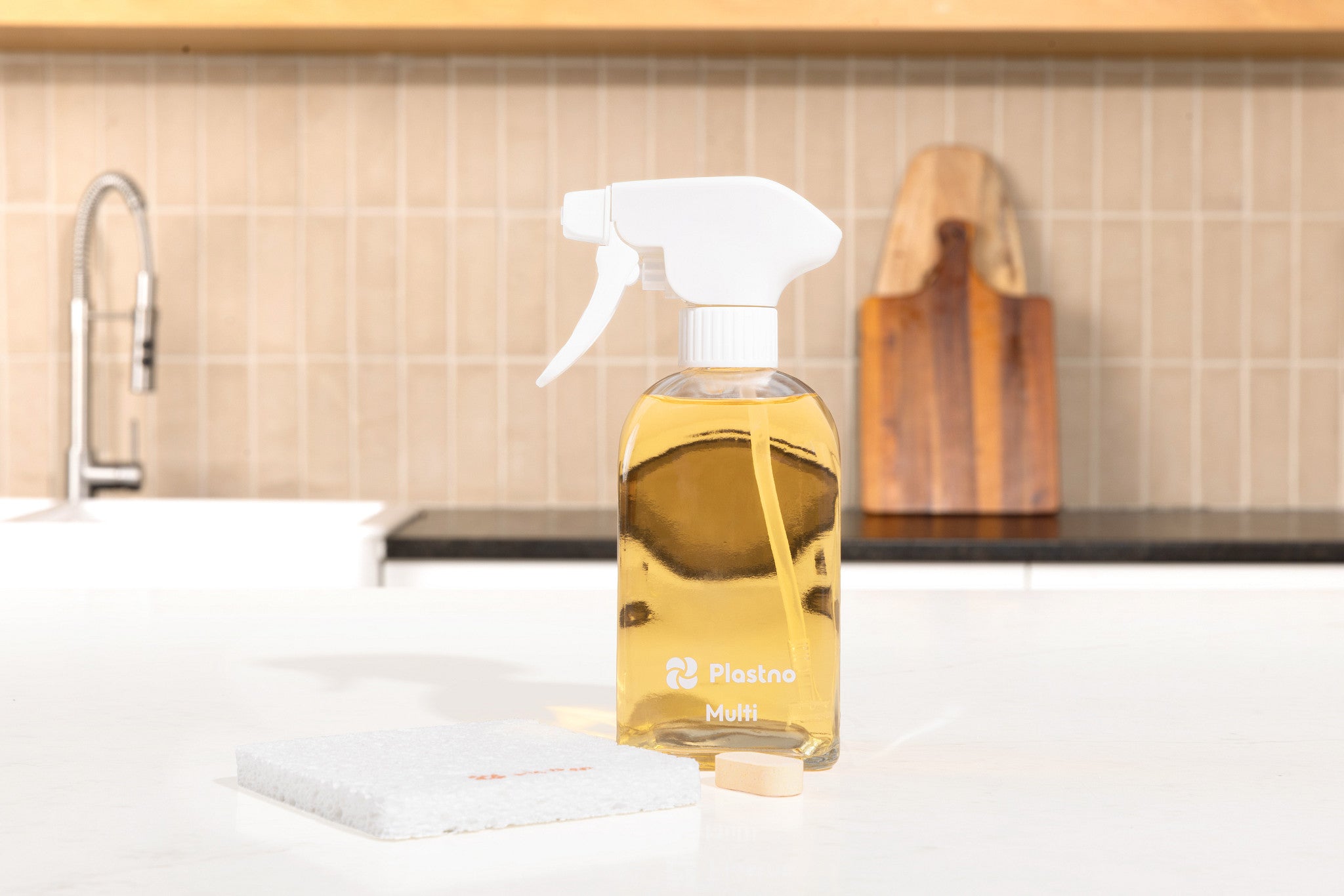
Making your own all-purpose cleaner is mostly a good idea. The ingredients are cheap, they are already in most kitchens, and you skip a plastic bottle at the store. The catch is that a homemade cleaner is only as good as its recipe, and a lot of the ones floating around online either do not work or quietly damage the thing you are cleaning.
We sell a cleaner, so read this with that in mind. We are also not going to pretend vinegar and baking soda do nothing. Below are the recipes that actually work, the exact ratios, what each one is safe on, and the combinations you should never mix. At the end, the honest case for when it is worth skipping the mixing altogether.
Read this before you mix anything
Three rules keep you and your surfaces safe.
- Never mix bleach with vinegar or with ammonia. Together they release chlorine or chloramine gas, and people land in the emergency room every year doing exactly this. If a recipe tells you to combine bleach with anything acidic, close the tab.
- Never mix vinegar with castile soap. The acid breaks the soap apart and you get a curdled white mess that cleans nothing. Both are useful, just never in the same bottle.
- Keep vinegar and other acids off natural stone. Marble, granite, travertine, and unsealed stone etch when acid sits on them, and the damage is permanent. Waxed wood is the same.
Two practical ones. Homemade cleaners have no preservative, so mix small batches and use them within a couple of weeks, especially anything with soap. And label the bottle, because an unmarked spray of clear liquid is a problem waiting to happen.
One thing worth saying plainly. Everything below cleans. None of it disinfects. Killing germs is a different job that needs an EPA-registered product, and no pantry recipe qualifies, ours included.
Four homemade cleaners that actually work
All-purpose vinegar spray
Mix 1 part white vinegar with 1 part water in a spray bottle. That is the whole recipe. It is good for glass, chrome fixtures, laminate counters, the inside of a trash can, and hard-water spots. Keep it off stone, waxed wood, and rubber gaskets. If the smell bothers you, drop a few strips of citrus peel in the bottle for a day. We go deeper on this one in our dos and don'ts of cleaning with vinegar.
Castile soap all-purpose cleaner
Stir 1 tablespoon of liquid castile soap into 2 cups of warm water. This is your option for greasy, grimy messes where vinegar falls short, on sealed counters, painted surfaces, and tile. Do not add vinegar to it. If you want a scent, a few drops of essential oil is fine.
Baking soda soft scrub
Combine half a cup of baking soda with just enough water or castile soap to make a paste, about 2 to 3 tablespoons. Use it for scrubbing jobs, sink basins, tubs, cooked-on spots on a sealed stovetop, and sheet pans. Rinse it off after. Skip it on soft glossy surfaces that scratch easily, like some glass cooktops and polished stone.
Streak-free glass and mirror spray
Mix 1 cup water, 1 cup rubbing alcohol, and 1 tablespoon white vinegar. This is best on glass and mirrors, and it is handy because glass is one of the few jobs a cleaning tablet is not built for. Spray the cloth rather than the mirror to keep drips from running behind the frame.
Want a vinegar-free option? The castile soap cleaner and the baking soda soft scrub use no vinegar at all, and you can leave the tablespoon of vinegar out of the glass spray if you would rather skip it entirely. Vinegar-free is also the safer route on stone, since acid is the thing that etches it.
Which cleaner for which surface
| Surface | Reach for | Keep away |
|---|---|---|
| Sealed stone counters (granite, quartz, marble) | Castile soap and water, or a tablet | Vinegar and any acid |
| Laminate or tile counters | Vinegar spray or castile soap | Nothing in particular |
| Glass and mirrors | Alcohol glass spray | Baking soda paste |
| Sealed stovetop | Castile spray, baking soda paste for cooked-on spots | Nothing in particular |
| Sinks and tubs | Baking soda soft scrub | Nothing in particular |
| Sealed wood | Damp cloth with a drop of castile soap | Vinegar, soaking wet |
| Stainless steel | Alcohol spray, wipe with the grain | Abrasive scrubs |
The honest limits of doing it yourself
Homemade cleaners are cheap and simple, and they have real downsides worth naming.
- Strength is a guess. Every batch is a little different, and none are tested for how much grease they actually cut.
- They do not keep. Without a preservative, a soap-and-water mix can turn in a few weeks, so you are making new batches constantly.
- Half your kitchen is off-limits to vinegar. The cheapest, most common recipe is the one you cannot use on stone, which is the surface most people most want to protect. We wrote a whole guide on what is safe for quartz and granite for that reason.
- It is a chore. Measuring, funneling, and re-mixing every couple of weeks is its own small job.
None of this makes DIY wrong. It makes it fiddly.
When to skip the mixing
This is the part we are biased about, so here is the plain version. Our Multi Cleaner Tablet is a pre-measured version of the same idea. Drop one tablet in a bottle of tap water and you get 16 oz of all-purpose cleaner at the same strength every time, with no measuring and nothing to re-mix.
It is mineral-based, fragrance-free, and dye-free, and the full recipe is eight ingredients, published on our ingredients page. There is no PVA film around the tablet and none in the formula.
Where it earns its place against the recipes above is stone. It is rated for sealed countertops, stovetops, sealed wood, and sealed stone including marble, granite, and quartz, exactly the surfaces you have to keep vinegar away from. It is not built for glass or mirrors, so keep that alcohol recipe for those. And like every recipe here it cleans rather than disinfects, because it is not EPA registered and we will not say otherwise. The tablets are Leaping Bunny certified cruelty-free.
If you are starting from nothing, the Multi Cleaner Set pairs the tablets with a refillable glass bottle so you are not hunting for a spare. After that you reorder the tablets on their own and keep the bottle. The mechanics are the same as any DIY spray, just with the guesswork removed, which is the whole idea behind making a spray from a tablet.
Whichever way you go, the greenest bottle is the one you already own, so use up what is under your sink before you switch. If you want to know whether those supplies are worth keeping, our free app Plastnofy lets you scan any cleaning product for a sustainability rating, suggests greener swaps, and tracks the plastic you save as you go.
Make the vinegar spray for your windows, keep the baking soda paste for the sink, and reach for a tablet on the stone you would rather not gamble on. The point is not one bottle for everything. It is knowing which cleaner belongs on which surface, and why.
Share:
Best Non-Toxic All-Purpose Cleaners Compared
How to Clean a Microwave Naturally (No Harsh Chemicals)