

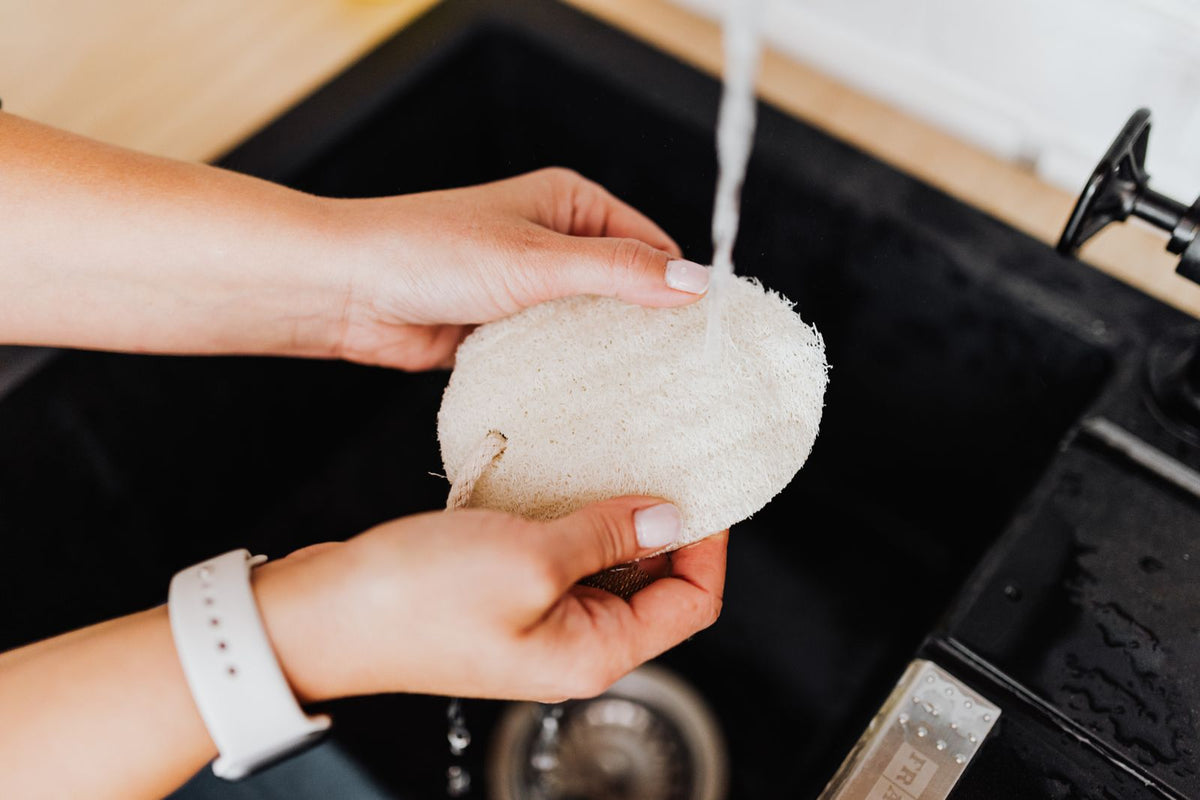
Turn your sponge's package over, if you still have it, and find the materials list. Most of us never read that part, and it is the only place the real answer lives.
Most kitchen sponges today are made from either plastic foam or cellulose, a plant material made from wood pulp, and plenty of them are both. The classic yellow sponge is usually polyurethane foam with a green scrub pad that is plastic too. A plain cellulose sponge is plant-based. Many sponges sit somewhere in between, with a cellulose body and a plastic layer on the scrubbing side.
That difference matters because plastic sponges wear down into tiny pieces of plastic as you scrub, and those pieces go down the drain with the dishwater. It also means you cannot judge a sponge by the front of the package. A sponge sold as cellulose can still be part plastic.
You should know where we stand. We make two plant-based sponges, so we have a stake in this. This guide covers every common sponge material, including the ones we do not sell, and shows you how to check any sponge label yourself.
What are kitchen sponges made of?
Here is the short version. The sections below explain each material, where it comes from, and what happens to it as it wears out.
| Sponge | What it is made of | Is it plastic? |
|---|---|---|
| Classic yellow sponge with a green scrub pad | Polyurethane or another plastic foam, with a plastic mesh or fiber scrub pad | Yes, both layers |
| Cellulose sponge with a scrub pad | A cellulose body with a plastic scrub pad, and sometimes a plastic lining between them | Partly |
| Plain cellulose sponge | Cellulose made from wood pulp | No, as long as there is no pad or coating |
| Melamine foam eraser | A hard foam made from melamine-formaldehyde resin | Yes |
| Loofah scrubber | The dried fibers of a ripe luffa gourd | No |
| Natural sea sponge | The skeleton of a sea animal | No, and it is mostly sold for the bath |
What is the soft part of a kitchen sponge made of?
On a classic two-sided sponge, the soft part is plastic foam. The Institute of Making's materials library describes it as polyurethane or another foamed plastic, made to copy the feel of a natural sponge.
Sponges were not always plastic. People cleaned with natural sea sponges for thousands of years, and the same materials library notes that by the 1950s they had been fished so heavily that the industry nearly collapsed. Plastic foam filled the gap. Commercial production of polyurethane foam began in 1952, and today most sponges are made from either plastic or cellulose.
Polyurethane sponges are cheap and soft, which is why they are everywhere. They are also plastic, so the foam that wears off as you scrub is plastic too.
What is the green scrub side of a sponge made of?
Usually plastic. The Institute of Making describes the thin, dark green layer as a harder polyethylene mesh laminated to the foam. The first sponge with this two-layer design was patented for washing cars, and the rough side was there to scrub off stuck bugs.
The exact plastic changes from brand to brand. One UK supermarket's own sponge, for example, lists its materials as cellulose for the sponge, polyethylene terephthalate for the scourer, and polyurethane for the lining. Polyethylene terephthalate, or PET, is the same plastic used for many drink bottles. Other sponges use polyester or nylon.
That is the catch with plant-based sponges. The soft body can be cellulose while the side you scrub hardest with is plastic. We checked seven plant-based sponges for exactly this in our dish sponge comparison.
On our Scrub Sponge, the scrub side is loofah. There is no nylon or polyester mesh behind it.
What are cellulose sponges made of?
Wood pulp. Cellulose is the fiber that gives plants their structure, and most cellulose sponges start as wood pulp. To make one, the pulp is dissolved with chemicals into a thick liquid called viscose, then expanded and set into a sponge, as this cellulose sponge patent describes. The finished sponge is a plant material, so it is biodegradable when it wears out.
A plain cellulose sponge has no plastic in it. Check the label anyway, because cellulose is also the body of many sponges that carry a plastic scrub pad or lining.
Our Soak Sponge is a single layer of plant-based cellulose with no scrub side. It ships flat at about one fifth the size of a foam sponge and expands the moment it gets wet.
What are magic erasers made of?
Melamine foam, a hard foam made from melamine-formaldehyde resin. It was first sold commercially in 1984, as soundproofing and insulation, long before it ended up under the kitchen sink.
The foam feels soft in your hand, but its tiny strands are very hard, so it works like extremely fine sandpaper. That is why it lifts scuffs that soap leaves behind. It is also why it can leave fine scratches on softer surfaces, so test a hidden spot first.
A melamine eraser wears away as you use it, much like a pencil eraser, and what wears off is plastic. In a study published in Environmental Science & Technology, researchers calculated that a melamine sponge releases about 6.5 million microplastic fibers per gram of sponge that wears off. For many scuffs, a little baking soda on a soft sponge does the same job.
What is a real sponge made of?
A real sea sponge is an animal. NOAA describes sponges as simple aquatic animals with dense but porous skeletons, often mistaken for plants. There are about 8,550 living species.
The soft natural sponges sold for bathing are the cleaned, fibrous skeletons of some of those animals. They are not plastic, but they are rarely sold for dishes. In the kitchen, cellulose and loofah are the usual plant-based choices.
What is a loofah made of?
A plant. Loofah comes from the luffa gourd, which belongs to the same family as squash and cucumbers. The young fruit is eaten as a vegetable in many parts of Asia. When it fully ripens, it becomes too fibrous to eat, and that dried web of fiber is the loofah.
Watch the name. Many people think loofahs are sea sponges, but they are not. And the mesh bath puffs often sold as loofahs are plastic.
In a kitchen sponge, loofah makes a firm scrub side that is plant-based all the way through. On our Scrub Sponge, the loofah side handles stuck-on food on cast iron, stainless steel, sinks, and stovetops, and the cellulose side is gentle enough for nonstick pans and glass.
Do kitchen sponges shed microplastics?
Yes, the plastic ones do as they wear down. A 2026 University of Bonn study, published in the journal Environmental Advances, found that every sponge it tested lost material during use and released microplastics. Sponges with less plastic in them shed significantly fewer particles.
The same study found something most sponge articles leave out. About 85 to 97 percent of the environmental impact of washing dishes by hand comes from the water, not the sponge. The researchers' advice was to use less water, choose sponges with less plastic, and keep sponges in use longer.
So if you want the biggest win at your sink, turn the tap down first. Then pick a sponge with no plastic in it, and look after it so it lasts. Our guide to making your kitchen sponge last longer covers the care.
How to tell if a sponge is plastic
You do not need a lab. You need the materials line on the package, and these four checks.
- Read the materials, not the front. Look for polyurethane, polyester, nylon, polyethylene, polypropylene, PET, melamine, or recycled plastic. Each of those is plastic, and recycled plastic wears down the same way new plastic does.
- Check every layer. The sponge, the scrub pad, and any lining between them can each be a different material.
- Do not trust the front of the pack on its own. Words like plant-based, natural, or cellulose can describe only the soft part of the sponge.
- If there is no materials list, ask. Contact the brand before you buy. A sponge with nothing to hide is easy to describe.
Can you still buy natural sponges?
Yes. Plain cellulose sponges, loofah scrubbers, and natural sea sponges are all still sold, though sea sponges are mostly found in the bath aisle. For the kitchen, cellulose and loofah are the closest swap for a two-sided foam sponge, because you keep a soft side and a scrub side.
Our Scrub Sponge and Soak Sponge are both plant-based and biodegradable. The Scrub Sponge is loofah and cellulose, and the Soak Sponge is cellulose, with no plastic layer in either. You can find both on our eco-friendly cleaning tools page, and our sponge ingredients guide explains each material we use.
Swapping your sponge is one of the easiest steps toward plastic-free cleaning, because sponges wear out anyway. You are not throwing away anything that still works. You are choosing differently next time. If you want to go further, our guide to avoiding microplastics in the kitchen covers the rest of the sink.
Product details current as of November 2026.


Share:
How to Clean Baseboards Without Damaging the Paint