


Every guide to avoiding microplastics gives you the same list. Stop drinking bottled water. Stop microwaving plastic. Move your leftovers into glass. Throw out the scratched cutting board. Buy cotton instead of polyester.
The advice is fine. We follow most of it. But it has a hole in it, and once you notice the hole it is hard to unsee.
Every item on that list is about plastic sitting still. Heat softens a container, time scratches a board, a synthetic shirt tumbles in a dryer. The exposure is passive. Nothing on the standard list covers the one moment in your kitchen where you deliberately grind two surfaces together, on purpose, several times a day.
Washing up.
Where kitchen microplastics actually come from
Microplastics arrive in a kitchen three ways.
Some come in with the food, already there before you open the packet. Salt, seafood, and heavily processed food carry particles picked up during production. You have very little control over that beyond cooking from scratch more often.
Some are released by heat and wear. A container that goes through the dishwasher a hundred times, a lid that gets microwaved, a chopping board that has been scored by a knife for three years. This is the category the standard advice is built around, and the standard advice is right about it.
The third category barely gets discussed. It is plastic you shed yourself, through friction, using a tool designed to be abrasive.
Your dish sponge is a block of plastic foam
Pick up the yellow sponge next to your sink. Unless you bought it specifically to avoid this, it is polyurethane foam with a polyester scouring layer bonded to one side. Both are plastic. The green scratchy pad is usually nylon.
A sponge works by abrasion. That is the whole function. Every time you scrub a pan, microscopic fragments come off the sponge, and they go where the water goes: onto the plate, down the drain, and onto the next thing you wash.
This is the part that makes the standard advice slightly absurd when you follow it end to end. You are told to move your leftovers out of plastic and into glass, which is good advice. Then you scrub the glass with a plastic sponge, dry it with a polyester microfiber cloth, and put your food in it.
Microfiber is worth its own mention. It is marketed as the clever, modern option and it is usually 100% polyester or a polyester and polyamide blend. It is plastic thread, and it sheds every wash.
You have not removed the plastic from the loop. You have moved it one step down the counter.
What to use instead
The swap here is unusually simple, because sponges are cheap and they wear out anyway. You are not throwing away something expensive, you are just choosing differently next time.
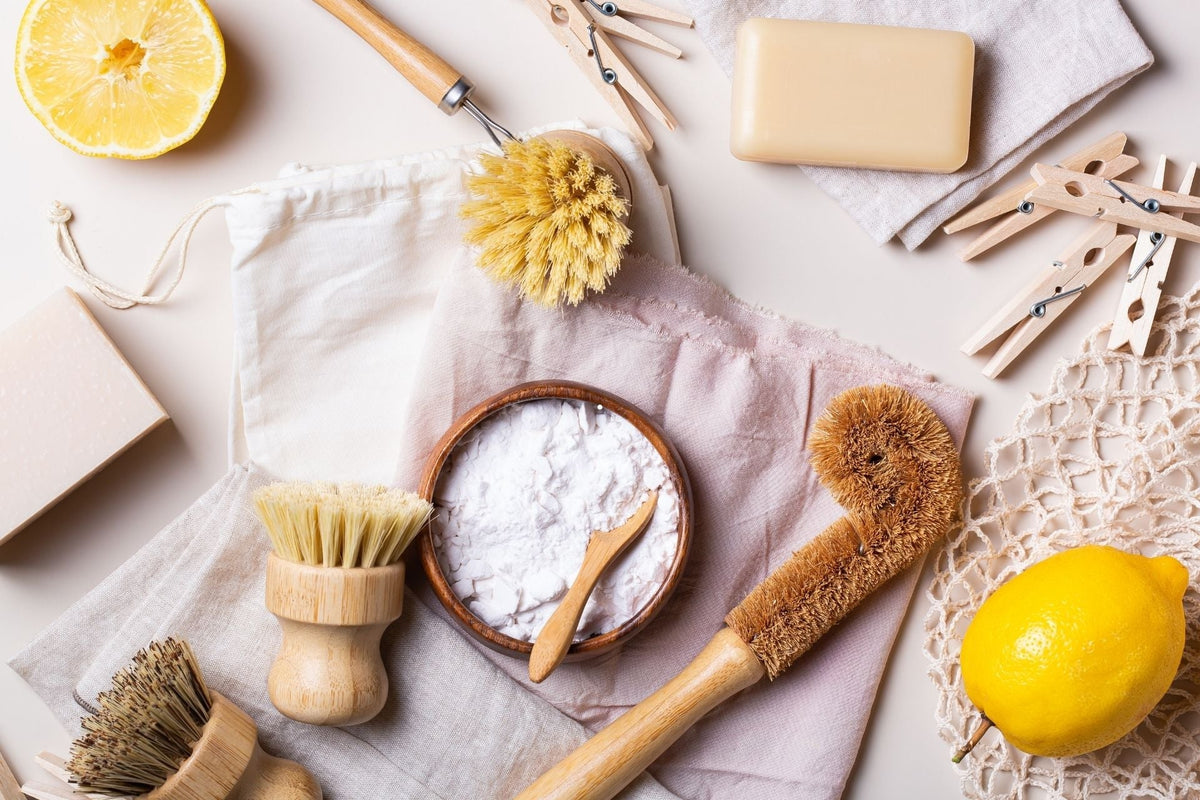
Look for cellulose. It is wood pulp, it holds water well, and when it wears out it breaks down instead of persisting. For the scrubbing side, loofah is a gourd, dried and cut. For drying and wiping, cotton does what microfiber does without the shedding. One thing to check before you buy: plenty of sponges sold as plant-based still have a synthetic mesh bonded to the scrub side, and we compared seven of them on materials, size, lifespan, and exactly that.
Our own scrub sponge is plant-based cellulose backed with loofah, and the soak sponge is cellulose without the abrasive layer for glassware and non-stick. Both are biodegradable and last two to four months depending on how hard you run them.
An honest note on the tradeoff, because most articles skip it: a cellulose sponge feels different. It arrives flat and dry and needs a moment under the tap to expand. It will not survive being left in a puddle at the bottom of the sink for a week, which is a habit worth breaking anyway. If you want it to last, wring it out and stand it up.
What about silicone
Silicone comes up constantly in this conversation, and the short answer is that it is not plastic and does not shed microplastics. It is built on a silicon and oxygen backbone rather than a carbon one. It is not a total non-issue either, and there is a two-second pinch test that tells you whether yours is the real thing or cut with plastic filler. We covered all of it in does silicone have microplastics.
Do tea bags have microplastics
Many do, and it is one of the more surprising items on the list.
The pyramid-shaped mesh bags that look like fabric are typically nylon or PET, both plastic. Steeping is close to a worst case: plastic, in a mesh with enormous surface area, held in near-boiling water for several minutes. Even conventional paper tea bags often use a polypropylene adhesive to seal the edges.
Loose leaf with a steel infuser sidesteps it entirely. If you prefer bags, look for ones that state they are unsealed or use a plant-based seal, and treat "silken" as a warning word rather than a premium one.
What actually moves the number
If you want to spend effort where it counts, the honest ranking looks something like this.
Stop heating food in plastic. Heat is the single biggest accelerator, and a microwave and a plastic lid is the fastest way to shed particles directly into a meal. This one is free.
Drink filtered tap water rather than bottled. Bottled water consistently tests higher, and a filter jug costs less than a month of bottles.
Change what you scrub with. This is the one almost nobody tells you, it is cheap, and it applies several times a day.
Replace plastic chopping boards as they scar. A scored board is shedding into whatever you cut on it.
Move storage to glass or steel over time, as containers wear out. You do not need to bin a working cupboard of plastic tomorrow. Replacing on failure is cheaper and produces less waste than a purge.
Notice what is not on that list: buying a whole new kitchen. Throwing out functioning plastic and replacing it in one weekend creates a pile of waste and a big bill, and does very little for your exposure that phased replacement would not have done anyway.
The realistic version
You cannot get to zero. Microplastics are in rain, in soil, in the air indoors. Anyone selling you a plastic-free life in five easy steps is selling you something.
What you can do is stop the sources you control, and start with the ones that are cheap and daily rather than expensive and occasional. A sponge is about as cheap and as daily as it gets, and it is the one the guides forget.
Share:
Unmasking Microplastics: The Hidden Danger Lurking in Our Everyday Lives
How to Store Compostable Trash Bags So They Last