

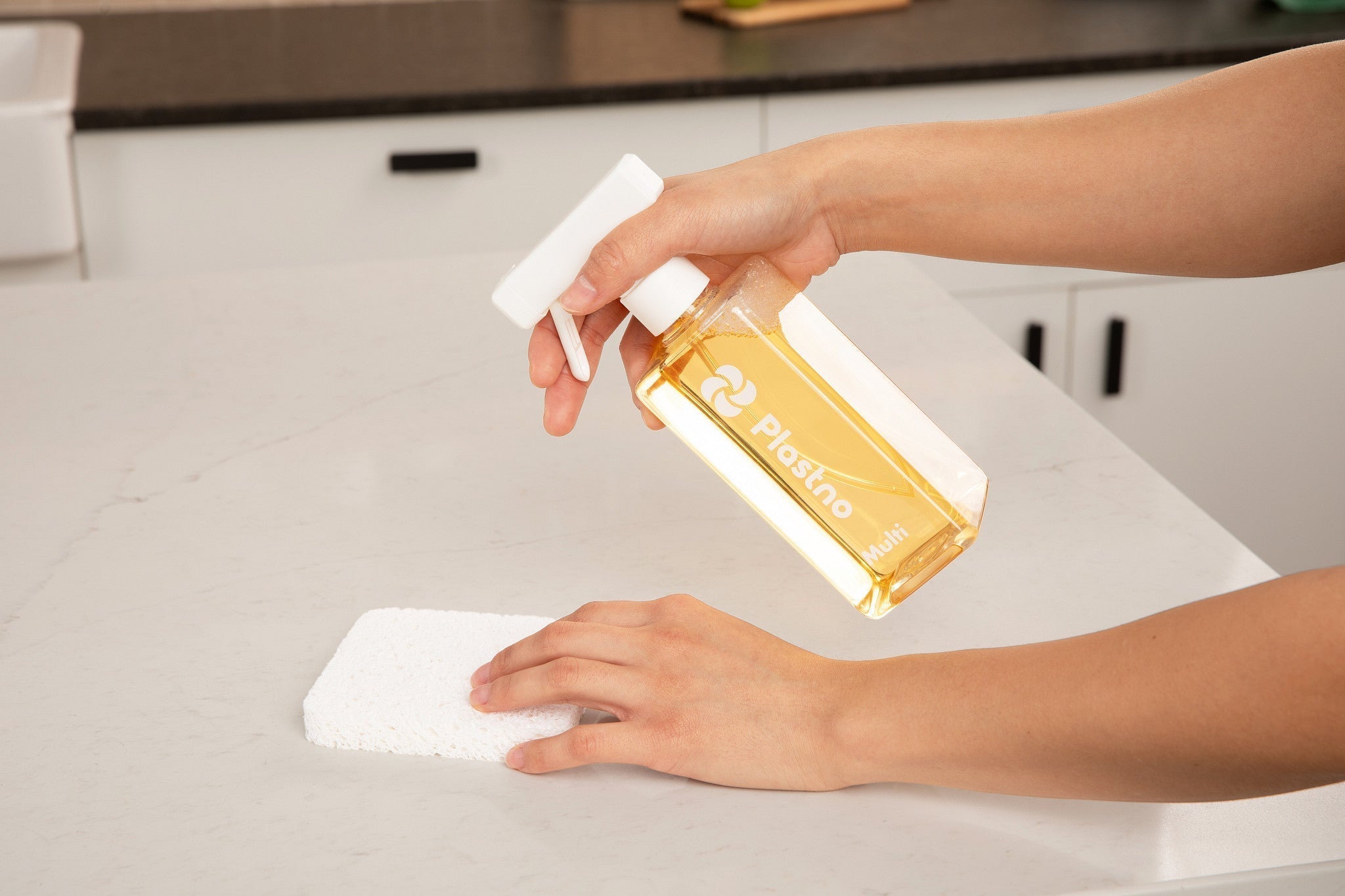
Search how to clean quartz countertops and you will get the same answer from nearly every result: mild dish soap and warm water. It is not wrong, exactly. It is also the reason so many people end up searching for how to clean quartz countertops without streaks a few months later.
Dish soap is engineered to cling to grease and stay put long enough to foam. That is useful in a sink full of dishes. On a non-porous surface like quartz there is nothing for it to soak into, so unless you rinse thoroughly and dry immediately, a thin film stays behind. Do that daily for a year and the film builds into the dull, cloudy haze people mistake for damaged stone.
Here is the method that actually works, what genuinely damages quartz, and how to handle the specific problems people run into.
The daily method
Quartz is one of the lowest-maintenance surfaces in a kitchen. It is engineered stone, roughly 90 percent ground quartz bound with resin, and it is non-porous. It does not need sealing and it does not need much.
Wipe crumbs away dry first, so you are not grinding grit across the surface. Then wipe with a cleaner that rinses clean, using a soft cloth. Follow with a dry cloth on the whole surface, not just the wet patch. That last step is what most people skip, and it is the one that prevents streaking, because streaks are almost always dried residue rather than a problem with the stone.
That is the entire routine. Quartz does not need polish, wax, or a sealer, and products promising to restore shine are usually adding a coating that attracts more residue.
Is Dawn dish soap safe for quartz?
Safe, yes. Ideal, no.
Dish soap will not etch quartz or damage the resin. It is a reasonable emergency option and it is why every countertop fabricator recommends it, since they are answering "what will not void the warranty" rather than "what cleans best."
The trade-off is residue. Dish soap contains surfactants chosen for foam and cling, plus thickeners, and often dyes and fragrance. On dishes you rinse all of that off under a tap. On a countertop you wipe it with a damp cloth and hope. What is left behind is the film that dulls the finish over time.
If dish soap is what you have, use very little, rinse with a clean damp cloth, and always dry the whole surface. The buildup complaint is a rinsing problem, not a soap problem.
What you should not clean quartz with
The genuine damage list is short and worth knowing, because most of it is slow and you will not connect the dull patch to the product you have used for a year.
- Vinegar and lemon. Acidic cleaners etch and dull stone. The natural-cleaning internet loves vinegar, and it is one of the worst things for quartz, granite and marble.
- Bleach. Can lighten the surface and, on engineered quartz specifically, degrade the resin that binds the stone.
- Ammonia and other strongly alkaline cleaners. High pH is hard on the resin bond and wears the finish, which makes staining more likely later.
- Abrasive powders and scouring pads. Steel wool and gritty cleaners leave micro-scratches that read as a dull patch.
- Oil soaps and wax-based polishes. Designed to leave a film. On a non-porous surface that film is the problem.
The pattern: quartz dislikes both extremes of the pH scale, and it dislikes grit. What it wants is something in the middle that lifts grease and then leaves.
Can you use disinfecting wipes on quartz?
This comes up constantly and the honest answer has two parts.
Most disinfecting wipes rely on quaternary ammonium compounds, and many quartz manufacturers advise against regular use because repeated exposure can dull the resin finish over time. Occasional use is unlikely to wreck a counter. Daily use is worth avoiding. Check your specific manufacturer's care guidance, since warranty terms vary by brand.
Worth being clear about the trade-off, though: if you are wiping raw chicken juice off a counter, you want an actual disinfectant, and a cleaner is not a substitute for one. Our tablets are not EPA registered, so they clean and we make no claim that they disinfect or sanitize. For everyday wiping, a cleaner is the right tool. For raw meat, use a registered disinfectant and accept the occasional wipe.
How to clean stained quartz
Quartz is non-porous, so most "stains" are actually residue sitting on the surface rather than something absorbed into it. That is good news, because it means it can almost always come off.
For dried food or something stuck on, do not scrub. Lay a warm damp cloth over it for a few minutes to soften it, then lift the edge with a plastic scraper or an old card. Never metal, never steel wool.
For sticky residue like adhesive or grease that will not budge, a 50/50 mix of isopropyl alcohol and water on the spot works and evaporates clean.
For a genuine discoloration, a paste of baking soda and water left on the spot for around ten minutes, then wiped away with a soft cloth, is the standard approach. Baking soda at pH 8.3 is mild enough for quartz, unlike its stronger cousin washing soda. If you want the difference explained, we wrote about washing soda versus baking soda versus borax.
Two things that will not fix a stain and may make it worse: scrubbing harder, and reaching for something stronger. Dull rings on quartz are frequently caused by someone rubbing at a mark rather than by the mark itself.
White quartz and why it shows everything
White and light quartz do not stain more than dark quartz. They simply show residue that darker stone hides, which is why people with white counters end up convinced their stone is defective.
The fix is the same, just applied more consistently: use less product, rinse properly, and dry the full surface every time. If a white counter looks cloudy, the most likely cause is accumulated cleaning product rather than damage. One thorough pass with a residue-free cleaner and a dry cloth usually reveals the finish underneath.
Granite and marble are not the same job
Quartz is engineered and non-porous. Granite and marble are natural stone, porous, and sealed, which changes the rules.
Sealed granite and marble need the same avoid-list, and acids matter even more because marble is calcium-based and etches readily. They also need the sealer maintained on schedule. Any cleaner, including plain water, will eventually cause problems on unsealed natural stone, so if you are unsure whether yours is sealed, test with a few drops of water in an inconspicuous spot. If it darkens within a few minutes, the sealer needs attention.
Why one cleaner instead of a stone-specific one
Walk through the stone-care aisle and there is a dedicated product for every surface: a stone cleaner, a stone polish, a quartz-specific spray, a granite sealer, a separate glass cleaner. Most of that exists because surface-specific products are easier to sell than one that quietly works, not because your kitchen needs five formulas.
The practical result is six or eight bottles under a sink, most half-used, each one its own piece of plastic. The sustainability argument here is not complicated: if one properly formulated cleaner handles the counters, the stovetop, and the sealed wood, that is one bottle instead of four, and if it refills, it is one bottle for years instead of four replaced repeatedly.
The catch is that the one cleaner has to actually be formulated for stone, which most all-purpose sprays are not.
How our tablets are built for this
The pH problem described above is the specific thing our formula solves. Sodium carbonate does the grease-cutting work, and on its own it would sit around pH 11, too alkaline for quartz resin. Tartaric acid moderates it down into a range that is safe on sealed stone. Two gentle plant-derived surfactants let the cleaner sheet across the surface and rinse away instead of clinging, and sodium phytate binds hard-water minerals so you do not get spotting as it dries.
That is the whole design goal: lift the grease, then leave. Eight mineral-based ingredients, published in full on our ingredients page, with no fragrance, no dye, and no thickeners whose job is to make a product feel substantial.
Our non-toxic cleaning tablets, the core of our non-toxic cleaners range, are formulated for sealed countertops, stovetops, sealed wood, and sealed stone including marble, granite, quartz, travertine and terrazzo. Drop one tablet into a refillable bottle with 16 ounces of warm water and leave it for 20 to 30 minutes to dissolve into a full bottle of cleaner.
The honest limits: they are for sealed stone, and unsealed natural stone needs resealing regardless of what you clean it with. They are not formulated for floors, and not for glass or mirrors, so they will not give you a streak-free window finish. They are not EPA registered, so no disinfecting claim. They are Leaping Bunny certified cruelty-free, which covers animal testing and nothing about ingredient safety.
If you would rather evaluate that yourself rather than take our word for it, we published a guide to checking which cleaning product claims hold up, including how to read an ingredient list and which certifications actually mean something.
Share:
Fragrance-Free vs Unscented Cleaners: What's the Difference?
Non-Toxic All-Purpose Cleaner for Homes with Kids and Pets