

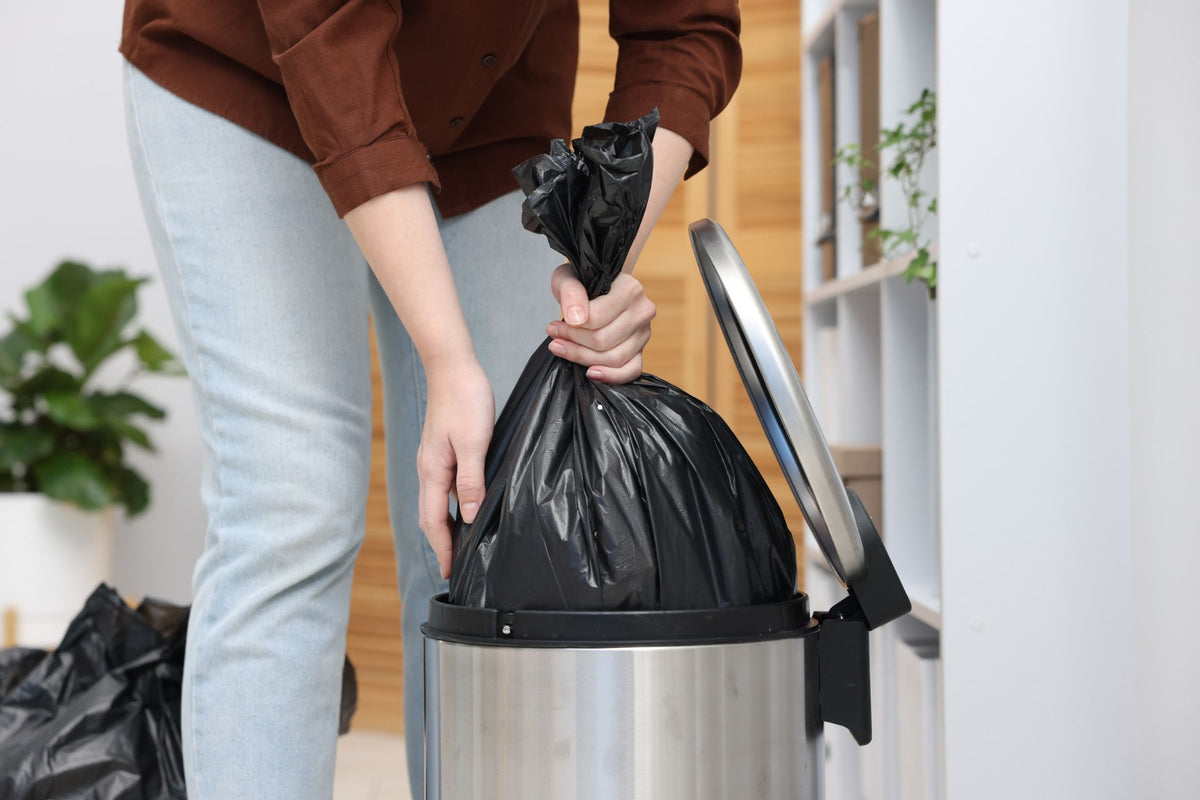
Most homes need two trash bag sizes, not five. A 13 gallon bag fits the standard tall kitchen can, and a 4 gallon bag fits a small bathroom or bedroom bin. Everything else on the shelf is for bigger jobs in the garage or the yard.
The trouble is that a gallon number on a box does not tell you if the bag will actually reach over the rim of your can. Two 13 gallon bags from two brands can differ by a few inches in height. That is the difference between a bag that folds over the edge and one that slips down inside every time you add something.
Full disclosure: we make compostable trash bags in two sizes, so we have a stake in this. The chart and the measuring method below work for any brand, and we will tell you plainly where our sizes fit and where they do not.
Trash bag sizes chart
Find the can you have, then read across to the bag size and its rough flat dimensions.
| Where the can is | Typical can size | Bag size | Typical bag dimensions (W x H) |
|---|---|---|---|
| Small bathroom bin | 2 to 5 gallons | 4 gallon (15 L) | 17 x 18 in |
| Large bathroom, bedroom, or home office bin | 6 to 8 gallons | 8 gallon (30 L) | 22 x 22 in |
| Standard tall kitchen can | 10 to 16 gallons | 13 gallon (49 L) | 23.75 x 25 to 27 in |
| Garage can | 20 to 30 gallons | 30 gallon (113.5 L) | 30 x 33 in |
| Large garage can | 20 to 33 gallons | 33 gallon (125 L) | 33 x 36 in |
| Wheeled outdoor cart or yard waste | 32 to 39 gallons | 39 gallon (148 L) | 33 x 41 in |
| Contractor and cleanup jobs | Loose debris | 55 gallon | 36 x 52 in |
Can sizes and bag dimensions in this chart come from Hefty's published size guide. Other brands land within an inch or two of these numbers, which is exactly why measuring your own can is worth the two minutes.
What are the standard trash bag sizes?
The three sizes most homes use are 4 gallon, 8 gallon, and 13 gallon. The 4 gallon bag covers small bathroom and desk bins. The 8 gallon bag covers bigger bathroom bins, bedroom cans, and laundry room cans. The 13 gallon bag covers the kitchen.
Above that, 30 and 33 gallon bags are for garage cans, 39 gallon bags fit most wheeled outdoor carts, and 55 gallon contractor bags are for renovation and yard cleanup. If you are not doing any of those, you can skip the big sizes entirely.
Are 13 gallon trash bags standard?
Yes. The 13 gallon tall kitchen bag is the standard kitchen trash bag size in the US. It is built for a kitchen can that holds 10 to 16 gallons and stands roughly 24 to 28 inches tall.
Laid flat, the standard 13 gallon trash bag size is about 24 inches wide and somewhere between 25 and 28 inches tall, depending on the brand. In metric terms, 13 gallons is about 49 liters. If your kitchen can is noticeably taller than 28 inches, or very wide, a 13 gallon bag will be a stretch, and a 16 or 20 gallon bag is the better fit.
What size trash bag do I need for a bathroom trash can?
A 4 gallon bag for a small bathroom bin, and an 8 gallon bag for a larger one. Most bathroom bins hold 2 to 5 gallons and stand 10 to 15 inches tall, which is the 4 gallon range.
The common mistake is buying a kitchen bag for the bathroom bin. It works, but most of the bag ends up bunched inside the can, and you throw away a lot of bag with very little trash in it.
How can I tell what size my garbage can is?
Check the bottom or the back of the can first. Many cans have the capacity printed or molded on. If yours does not, measure it. This is the method commercial can liner makers use:
- Bag width: measure all the way around the rim of the can with a soft tape, then divide by two. No soft tape? Measure straight across the top of a round can and multiply by 1.57.
- Bag height: measure the height of the can, add half the width of the bottom, then add 3 to 4 inches so the bag folds over the rim.
- Square or rectangular cans: use the corner-to-corner measurement across the bottom in place of the width of the bottom.
That method comes from can liner maker NASSCO's measuring guide. As an example, a round can that is 12 inches across measures about 38 inches around the rim, so it needs a bag at least 19 inches wide.
To work out capacity in gallons, multiply the height, width, and depth of the can in inches, then divide by 231, which is the number of cubic inches in a gallon.
If your numbers fall between two bag sizes, go up a size. A bag that is slightly too big just folds over a little more. A bag that is too small slips, tears at the rim, or will not tie.
Which matters more, bag width or bag height?
Width, almost every time. A bag that is too narrow will not open around the rim at all, so it either rips or will not go on. A bag that is a little short still works, it just leaves less to fold over and less to tie.
If a bag fits but keeps slipping down into the can, the size is usually fine and the setup is the problem. We wrote about two ways to seat a trash bag so it stays put.
Does trash bag thickness change the size you need?
No. Thickness and size are separate choices. Size is about fitting the can, and thickness is about what you put in it. A heavy, sharp, or wet load needs a thicker bag in the same size, not a bigger bag. If you are weighing thickness as well, our guide to trash bag thickness covers what the mil numbers mean.
Compostable trash bags in the two sizes most homes use
This is where we come in. We make compostable trash bags in the two sizes most homes actually need, and we kept both a little roomier than the typical bag in the chart above.
- Kitchen: our 13 gallon compostable trash bag is 24 inches wide by 28 inches tall with a drawstring, slightly wider and taller than the typical 13 gallon bag.
- Bathroom and small bins: our 4 gallon compostable trash bag is 17 inches wide by 19 inches tall with a drawstring, an inch taller than the typical 4 gallon bag.
- Certified for two kinds of compost: both are BPI certified for commercial composting facilities and TUV OK Compost HOME certified for a backyard compost pile. Food scraps and the bag can go to compost together.
A few honest limits. We only make these two sizes, so for a garage can or an outdoor cart you will need a different bag. Both come 30 to a roll, which is a smaller pack than a big-box box. A compostable bag also has a shelf life of about a year, so it is better to buy what you will use than to stock up. And it only composts if it reaches a compost system, backyard or municipal. In a landfill it does not compost, because a landfill does not have the oxygen and microbes composting depends on.
If either size fits your cans, you can see both on our compostable trash bags page.
Product dimensions and certifications current as of October 2026.

Share:
How to Clean a Wood Table (and Sticky Wood Furniture)