

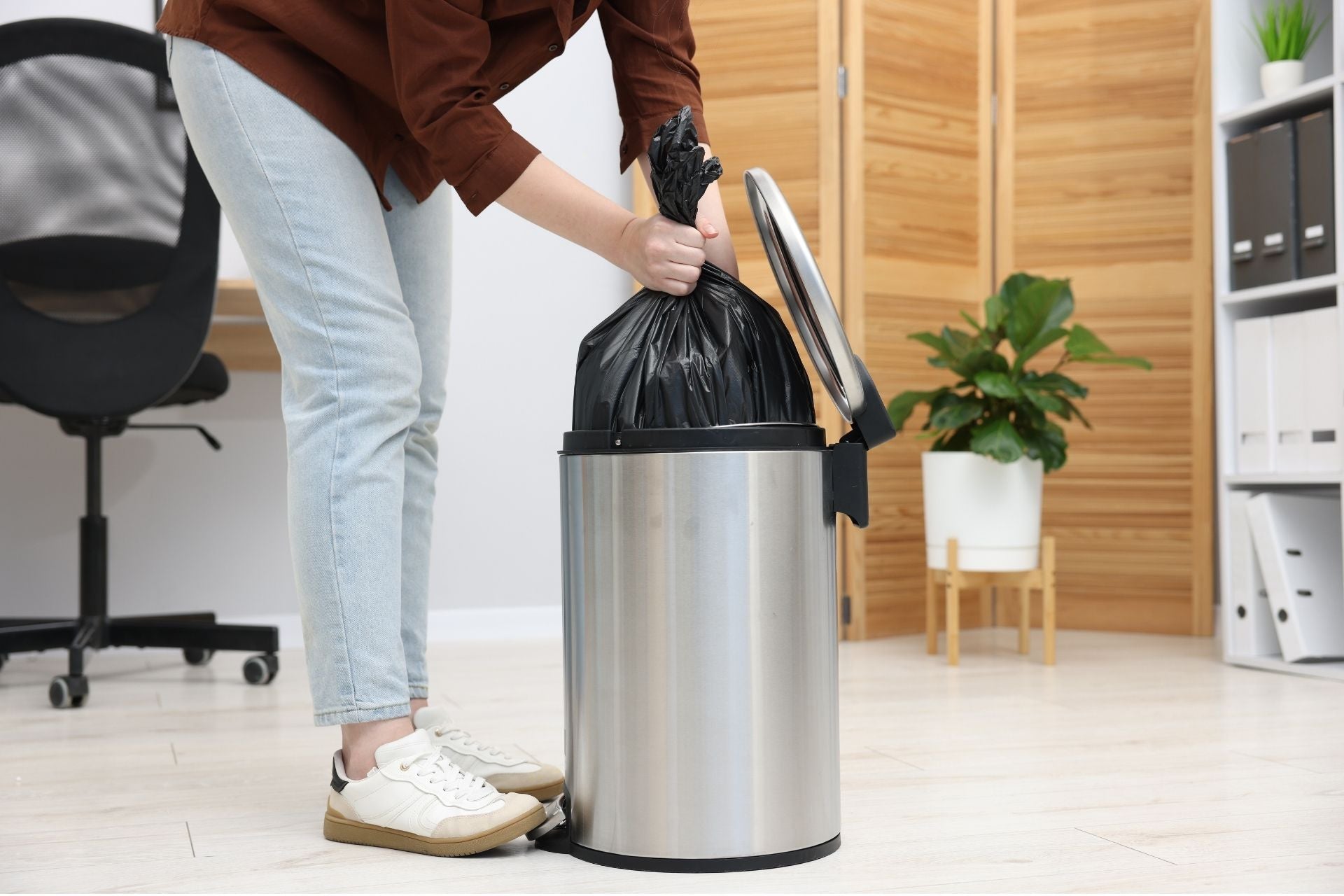
A trash can gets dirty in a way most household surfaces never do. Liquid pools in the bottom, dries, and leaves a film that a new bag sits right on top of. That film is what you are actually smelling, and no amount of air freshener touches it.
Fair warning about who is telling you this: we make compostable trash bags, so we have a stake in what goes in your can. Almost none of this guide needs a product from us. The job is mostly dish soap, hot water, and a brush, and we would rather say that than sell you something you do not need.
Most guides on this assume you have a driveway and a garden hose. Plenty of people have neither. So the no-hose method comes first.
What you need
Five things, and you probably own all of them:
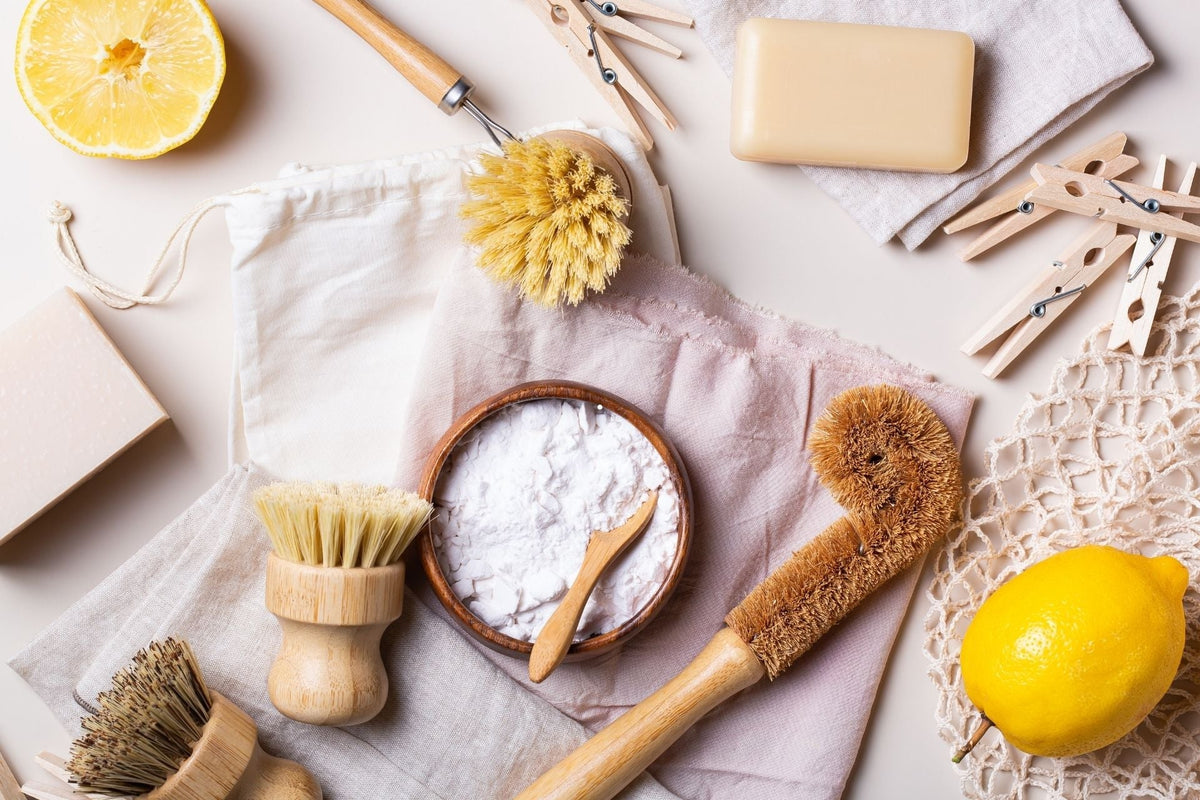
- Dish soap
- Hot water
- A long-handled brush, or a scrub sponge on a stick if the can is deep
- A cloth or towel for drying
- Rubber gloves
Nothing specialized. If you want a scrubber that is not made of plastic foam, our scrub sponge is plant-based cellulose and loofah and is biodegradable, but a brush you already own works just as well here.
How to clean a trash can without a hose
This is the apartment version. No yard, no drain outside, no pressure washer. It works in a bathtub, a shower stall, or on a balcony.
- Empty it and take the bag out. Check the bottom for anything stuck on.
- Pour in about two inches of hot water and a good squirt of dish soap. Do this with the can already where you plan to work, because it gets heavy fast.
- Let it sit for fifteen minutes. This is the step people skip, and it is the one doing the work. Soaking softens the dried film so you are not scrubbing at cement.
- Scrub the bottom, then the sides, then the rim and the lid. The rim and the underside of the lid collect more than people expect, because that is where drips land.
- Tip the water into the tub or toilet and rinse with a cup or a shower head. A handheld shower head is the closest indoor substitute for a hose.
- Dry it completely. Towel out the bottom, then leave it open somewhere with airflow until it is bone dry. A damp can is how the film starts again.
If you have no tub and no balcony, do it in stages over a garbage bag laid flat: soapy cloth, rinse cloth, dry cloth. Slower, but it works, and nothing drips on the floor.
How to clean a kitchen trash can
Kitchen bins are smaller and get dirtier faster, because food waste is most of what goes in them. The method above works as is. Two things change:
Do it right after you take the bag out, not as a separate chore. The can is already empty and you are already standing there. This is the difference between cleaning it every few weeks and meaning to clean it someday.
Deal with the pedal and the hinge. Step cans have a mechanism that traps gunk where you cannot see it. Wipe along the pedal arm and inside the lid hinge with a soapy cloth. If the can has a removable inner bucket, take it out and wash both pieces.
Once the can is out of the way, the floor and counter around it usually need attention too. That area is a sealed surface, so a multi cleaner tablet in a spray bottle handles it. Worth being precise here: that is for the counter and the sealed floor around the bin, not for the inside of the can itself.
How to clean an outdoor rolling cart
The big wheeled cart the city collects from is a different job, mostly because of scale.
Tip it on its side on a lawn or a gravel patch, not on a driveway that drains to a storm sewer. Rinse the loose material out first. Then a few inches of hot soapy water, twenty minutes to soak, and a long-handled deck brush. Tip it, rinse, and leave it upside down in the sun to dry.
Sun matters more here than indoors. A cart left open and dry in direct sun stays fresh noticeably longer than one closed up wet.
If the cart belongs to your city rather than to you, check the rules before you use anything stronger than dish soap. Some municipalities have specific guidance about what can go down the storm drain.
Cleaning a trash can is not the same as disinfecting it
Almost every guide on this topic tells you to disinfect the can. It is worth knowing what that word actually means, because it is a regulated term and not a synonym for clean.
In the US, a disinfectant is a type of pesticide. The EPA defines disinfectants as products "used on, nonliving surfaces and objects to destroy or irreversibly inactivate infectious fungi and bacteria but not necessarily their spores," and sanitizers as products "used to reduce, but not necessarily eliminate, microorganisms from the inanimate environment to levels considered safe as determined by public health codes or regulations." Those definitions are on the EPA's antimicrobial pesticides page.
A product cannot make those claims unless it has been through EPA review. The EPA puts it plainly: registered antimicrobial products "may not make efficacy claims against these pathogens unless the Agency has reviewed data to support the claim and approved the claim on the label."
Our cleaning tablet is not EPA registered, so we do not make those claims and you will not see them anywhere on our site. What soap and water do is different and, for a trash can, mostly sufficient: they physically remove the residue that odor-causing bacteria feed on. Take away the food, and the smell has nothing to live on. If you specifically want a disinfected can, you need a registered disinfectant and you need to follow its label, including the contact time, which is usually longer than people leave it on.
Should you sprinkle baking soda in your trash can?
Yes, and it helps, but it is doing less than people think.
Baking soda is alkaline, so it neutralizes acidic odor compounds. That covers a decent share of food smells. It does not stop the residue from forming, and it does not do anything for smells that are not acidic. Think of it as buying time between cleanings rather than replacing them.
Sprinkle it in a dry can before the bag goes in. In a wet can it clumps and becomes another thing to scrape out.
Can you use vinegar to clean a trash can?
For the cleaning itself, dish soap is better. Soap is a surfactant, which means it lifts grease and food film off the plastic. Vinegar is an acid, so it is good on mineral deposits and hard water marks and less good on the greasy layer that is actually the problem in a trash can.
Where vinegar earns its place is the rinse. A diluted vinegar wipe after the soap step cuts any soap residue and leaves less for dust to stick to.
One safety note that matters: never mix vinegar with bleach. The combination releases chlorine gas. If you use bleach on a cart, rinse it thoroughly and let it dry before anything acidic goes near it.
What to do when there are maggots
This is the search that brings most people here in July, so it deserves a straight answer.
Maggots are fly larvae. A fly laid eggs on exposed food waste, usually because a bag was left open or a bag leaked. A full kettle of boiling water poured straight into the can deals with them on contact. Pour, wait a minute, tip it out somewhere that is not your lawn, then do the full soapy soak above.
The part that stops it happening again is not the cleaning, it is the lid and the bag. Eggs need access to the food. A lid that closes and a bag that has not split are the whole defense.
How often should you clean a trash can?
Once a month for an indoor kitchen bin in warm weather, and every two or three months in winter. Outdoor carts, two to four times a year, weighted toward summer.
That is a starting point, not a rule. The honest test is simpler: clean it when the empty can still smells with the bag out. If it does, the film is there regardless of what the calendar says.
What actually keeps a bin from getting dirty
All of the above is treatment. The prevention is duller and more effective.
A bag that fits and does not leak is most of it. Almost every dirty trash can is a bag that split, slipped down inside, or was overfilled until liquid ran over the top edge. Getting the bag seated properly is its own small skill, and we wrote about two ways to do it.
Drain wet waste before it goes in, and keep food scraps in a separate lidded caddy rather than loose in the main bin. We covered that routine in more depth in our guide to stopping food scrap odors, and if your bags themselves are the source of the smell, that is a different problem with a different fix.
On the bag itself: our 13 gallon Waste Bag Tall is 24 inches wide by 28 inches tall with a drawstring, made from a cornstarch, PLA, and PBAT blend. It is BPI certified for commercial composting and TUV OK Compost HOME certified for backyard compost, which means the bag and the food scraps can go the same way instead of being separated.
Two honest caveats. Ours come 30 to a roll, which is the smallest pack in the category, so if you go through bags quickly you will reorder more often than with a big-box box of 200. And a compostable bag only helps at the end of its life if it actually reaches a compost system, backyard or municipal. In a landfill it is not composting, because a landfill does not provide the oxygen and microbial activity that composting depends on. You can see the full range on our compostable bags page.
Product specifications and certifications current as of August 2026.
Share:
Does Silicone Have Microplastics
Best Non-Toxic Dish Sponges Compared